
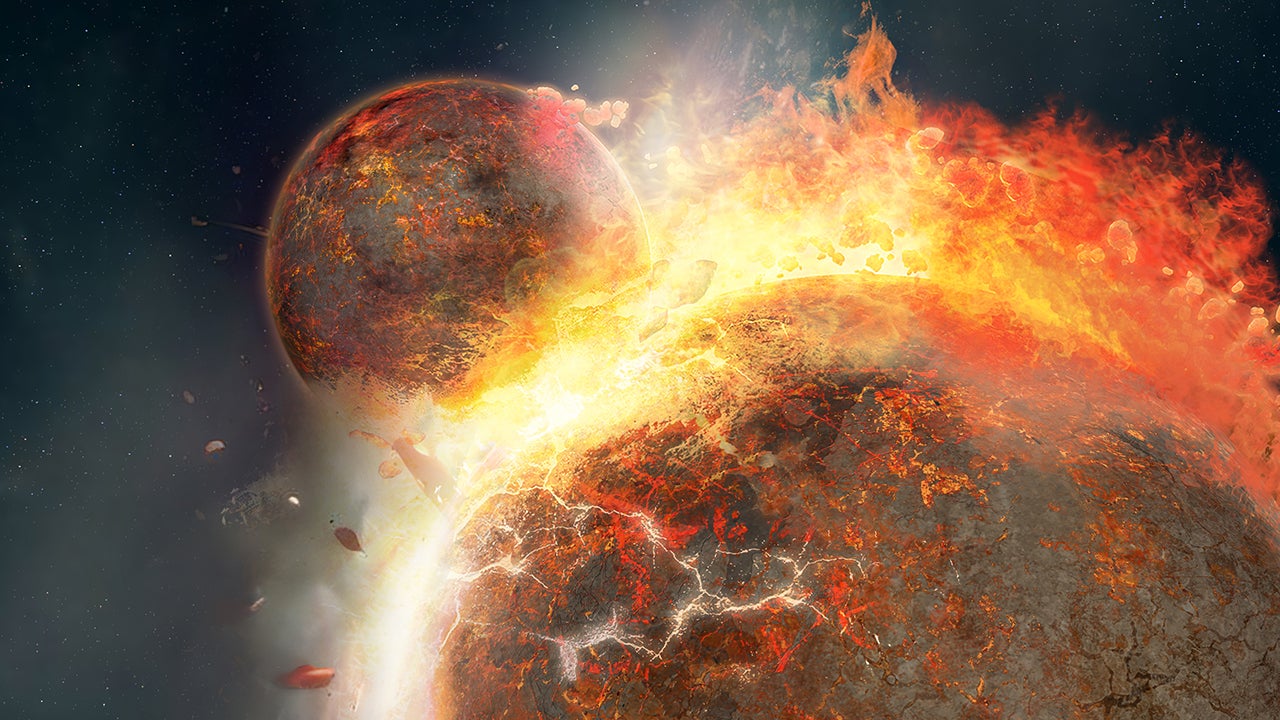
Scientists believe that fragments of an ancient Mars-sized planet known as Theia may be deeply embedded into earth's mantle close to our planet's core. The theory suggests that Theia collided with earth around 4.5 billion years ago, a seismic event that ultimately led to the creation of the moon.
Computer simulations offer support for the hypothesis that two substantial volumes of material located underneath Africa and the Pacific Ocean are potentially Theia remnants. Scientists first discovered these large formations in the 1980s, noting that seismic waves move slower through these areas, indicating that their composition is dense and distinct from other parts of the earth's mantle.
The researchers contend that Theia might have had a profound impact on earth, melting the upper mantle but leaving the lower half mainly intact. Earth may have absorbed about 10% of Theia's mass, which would account for the enormity of the deposits in the mantle that we observe today.
Whilst these new computer simulations do not offer conclusive evidence, they strengthen the theory that these deposits are indeed leftovers of an ancient world deeply buried within the earth's mantle. Scientists plan to investigate how the absorption of foreign matter could have influenced Earth's evolutionary trajectory and contributed to the formation of Earth's first continents.


Samira Khan
Samira Khan is a narrative enthusiast with a keen eye for storytelling in games. Her literary approach to game criticism examines themes, character development, and plot structure, earning her a following among gamers who appreciate the art of narrating.
Read more articles from Samira Khan
Trending News



Comments
No comments yet. Be the first to comment!