
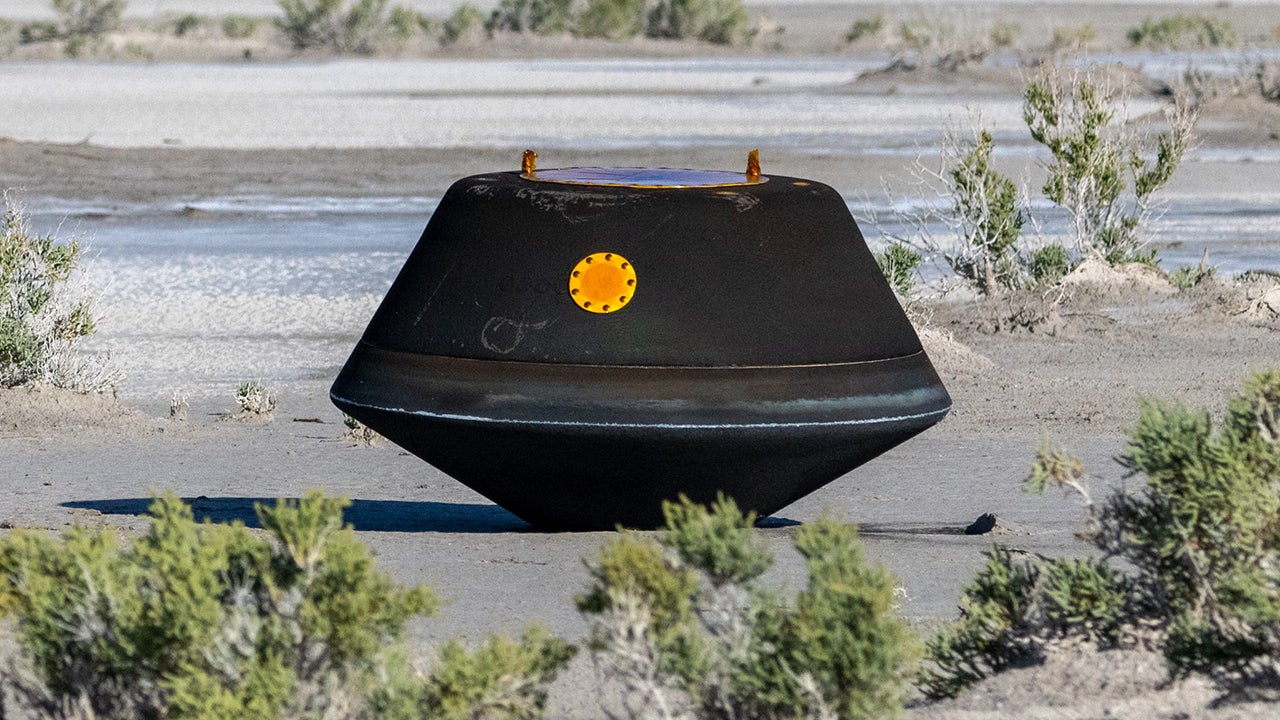
NASA has successfully returned a sample from the ancient asteroid Bennu to Earth, marking the completion of an ambitious 7-year long mission. The sample is expected to provide researchers with an unprecedented opportunity to study the secrets of our solar system's formation and the evolution of life around the Sun, according to Dante Lauretta, the principal investigator for the OSIRIS-REx mission at the University of Arizona.
Launched on Sept. 8, 2016, the OSIRIS-REx spacecraft was tasked with retrieving an ancient piece from asteroid Bennu, a half-kilometer-wide object that has been largely untouched since the solar system's formation. After reaching Bennu in December 2018, the probe studied the asteroid for almost two years before collecting a sample from its surface in October 2020.
The collected sample, sealed in a capsule within the spacecraft, then embarked on a two-year solo journey back to Earth, culminating in a fiery descent through our planet’s dense atmosphere and a dramatic landing in the Utah desert on Sept. 24, 2023. Following touchdown, the capsule was swiftly transferred into a clean room environment and subjected to a nitrogen purge to avoid contamination by Earthly particles.
Up next, the 250-gram sample will be taken to NASA's Johnson Space Center in Houston to be opened and studied for the first time in two years before being distributed to the global scientific community. Meanwhile, the OSIRIS-REx spacecraft is set to continue its mission, gearing up to orbit the near-Earth asteroid Apophis in 2029.
In summary, the successful return of the Bennu sample stands testament to NASA's innovation and could potentially unfurl the mysteries of our solar system's formation, potentially hazardous asteroids, and the evolution of life on Earth.




Samira Khan
Samira Khan is a narrative enthusiast with a keen eye for storytelling in games. Her literary approach to game criticism examines themes, character development, and plot structure, earning her a following among gamers who appreciate the art of narrating.
Read more articles from Samira Khan


Comments
No comments yet. Be the first to comment!