
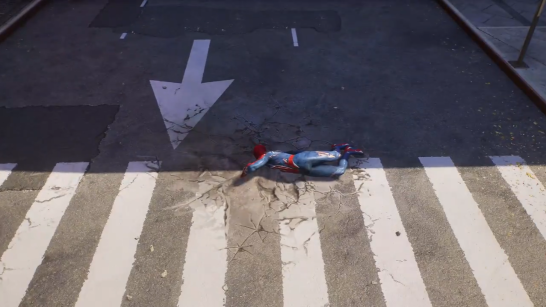
Insomniac’s Spider-Man 2 has caused debate among fans with the introduction of an optional fall damage feature. The game allows players to wingsuit across New York, and if desired, experience fall damage when failing a web swing. This addition has sparked discussions whether such damage aligns with the protagonist's superhuman abilities. IGN reader Drogom argued in favor of fall damage, seeing it as a crucial element in open-world games that enhances immersion and necessitates mindful traversal. The argument in opposition questions the concept's realism in a superhero context, given the arachnid nature of the characters.
To scrutinize these claims, IGN conducted an investigative venture into whether the spider heroes can potentially incur fall damage. They referred to the nature of spiders that were responsible for the characters' superpowers, examining their size, weight, and fall rate, with a focus on Miles Morales' genetically engineered OsCorp spider. The physics of falling objects in non-vacuum environments considered, a small spider would collide with the ground at a slower pace than a human. Consequently, even if reaching its maximum falling rate or terminal velocity, the spider likely wouldn't be seriously harmed.
Daniel Dombrowski, a 'spider veterinarian' confirmed to IGN that small spiders, along with other small animals, can often fall from considerable heights without suffering significant external or internal damage. Their survival could be attributed to their anatomy, behavior, and structure. One example he gave was the "ballooning" behavior, wherein spiders spin thin silk threads to glide safely towards the ground.
Despite these facts, human embodiments of the characters, Peter Parker and Miles Morales, couldn't replicate the spider's fall dynamics due to their humanoid form and proportional body mass. Their bodies, although transformed by the spider bites into superhuman endurance levels, follow standard rules of physics. Hence, they would likely collide with the ground at speeds similar to normal humans if they fell from the tallest buildings in the game's setting.
Interestingly, although the spider bites didn't impart their surface area properties to the heroes, they did bestow upon them superhuman strength and resilience. For instance, spider silk can exhibit strength five times that of a steel equivalent, allowing some spiders to bear up to 170 times their weight. Bucking the scientific approach, IGN sought the opinion of Jesse Schedeen, one of their staff writers and an acknowledged comic book nerd. Citing a 2005 Marvel Knights Spider-Man comic, Schedeen suggested Spider-Man can certainly sustain fall damage under specific circumstances, despite his proportionate spider strength and agility.
Consequently, scientific reasoning, alongside Spider-Man lore, suggests that the characters indeed could experience fall damage. This concept is moreover reiterated in the gameplay dynamics envisioned by Insomniac. Both Parker and Morales can be seen incurring harm from various impacts, including but not limited to being shot, stabbed, bludgeoned, and severely smacked by street thugs. Nevertheless, IGN noted inconsistencies between the comic and game universes regarding how Spider-Man and Miles Morales sustain damage. The fall damage feature in Spider-Man 2 is, however, optional and turned off by default not to disrupt players' immersive experience unless they wish otherwise.
IGN's review ranked Spider-Man 2 as 8/10, commending it for delivering "Insomniac's best tale yet" despite falling slightly short in the open-world aspect. They praised it as a "reliably fun superhero power trip" and encouraged players to check out IGN's comprehensive guide and city map for an optimum gameplay experience.
Anthony Wood, an experienced freelance contributor covering science and gaming news for IGN, provided these insights.



Samira Khan
Samira Khan is a narrative enthusiast with a keen eye for storytelling in games. Her literary approach to game criticism examines themes, character development, and plot structure, earning her a following among gamers who appreciate the art of narrating.
Read more articles from Samira Khan

Comments
No comments yet. Be the first to comment!