
In an absolutely mind-blowing experiment, former NASA engineer and popular YouTuber Mark Rober has collaborated with scientists from California’s Salk Institute and Brigham Young University to create the smallest model of a ‘Nerf Gun’ ever, utilizing DNA strands.
Mark Rober, who gained fame through YouTube after a successful stint at NASA’s Jet Propulsion Laboratory, previously built the largest Nerf Gun in history and today possesses over 25.9 million subscribers. For his latest experiment, he decided to turn the tables and create some of the smallest Nerf gun models in the world.
To kickstart this project, Rober sought the help of his former university, Brigham Young University, where a group of students guided by Professor Larry L. Howell designed a mini Nerf gun that could sit atop a finger. Constraints on size meant that regular Nerf Gun engineering wouldn't work and hence, the team chose to construct the model from a single 3D-printed block to avoid friction. Their effort yielded a functional model that could fire a bullet a considerable distance for its size.
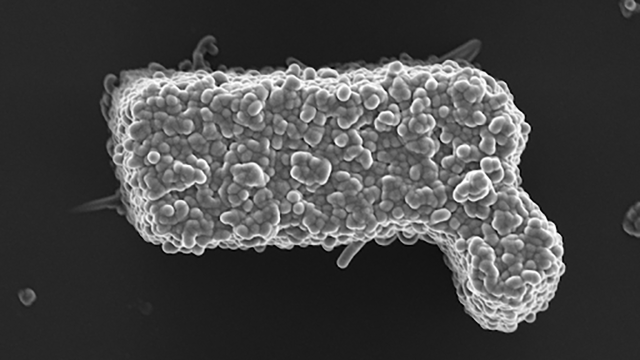
Rober didn't stop there, he took the design to the University’s micromechanics lab and used carbon nanotubes to create a microscopic, functional version of the Nerf gun, which turned out to be 100 times tinier than its predecessor. To give a sense of its size, it was so small that it quite literally disappeared under an ant! To view and fire this incredible invention, scientists used an electron microscope and robotic micromanipulator needle.
Next, the scientists used the same technique to create outlines of Nerf Guns, 10,000 times smaller than the original model and barely one-fifth the width of a human hair.
For the grand finale, Rober turned to the Salk Institute, where they birthed a Nerf gun from strands of DNA, a molecule found in every cell of our bodies that provides instructions for our physiological functions. Using complex techniques, they coaxed the DNA strands to form the shape of a Nerf Gun, creating models that were around three million times smaller than original ones. When viewed under an atomic force microscope, Nerf Guns which were approximately two-thousandths the width of human hair emerged, made of just a few thousand atoms.
Interestingly, according to assistant professor Pallav Kosuri, this project helped researchers envision potential medical applications, such as developing DNA-based drug delivery systems for better, safer treatment. Thus, this ultra-tiny Nerf gun might just inspire a breakthrough in medical treatment! So, if you're keen on seeing these scientists shrink the world, don't miss this episode on Mark Rober's YouTube channel.



Casey Loh
Casey Loh is a tech-savvy writer who specializes in the intersection of gaming and technology. With a background in computer science, Casey brings a technical lens to her reviews, breaking down the nuts and bolts of game engines, graphics, and AI innovation.
Read more articles from Casey LohSpotlight game

Trending News



Comments
No comments yet. Be the first to comment!