
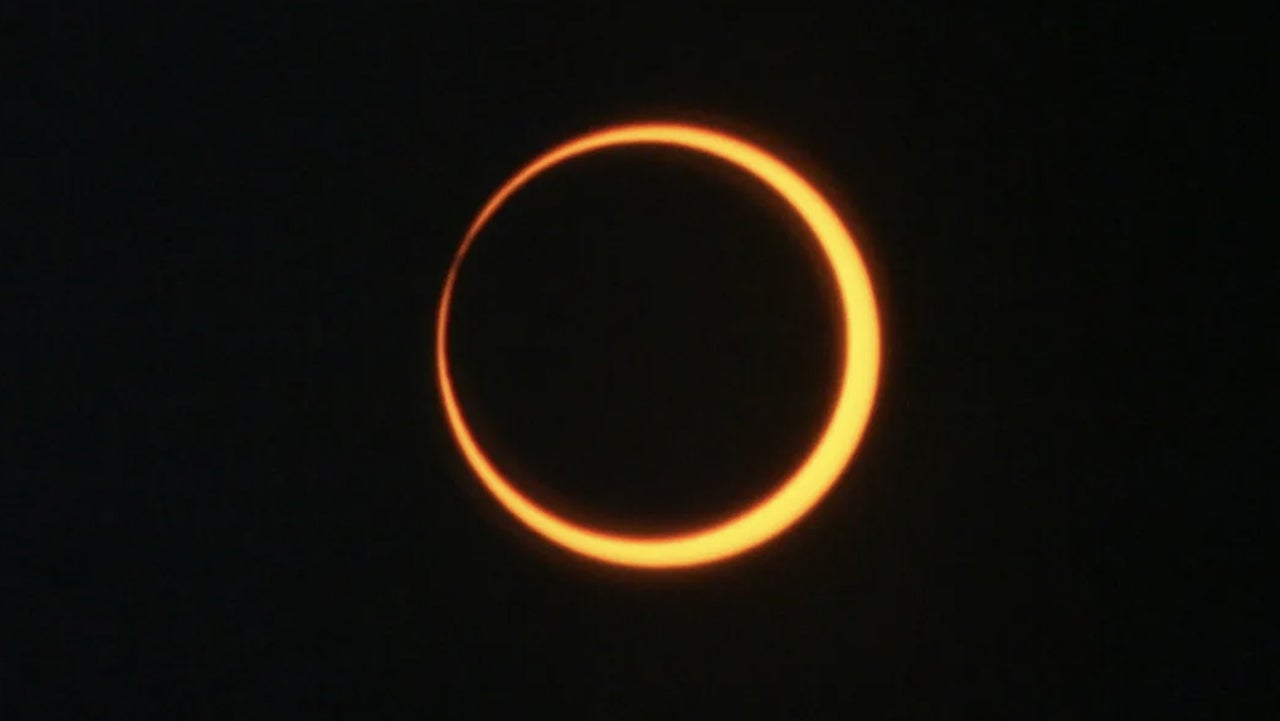
A "Ring of Fire" solar eclipse is on its way on October 14, and large parts of North America are in for this cosmic performance.
The Moon will align directly between Earth and the Sun, creating a halo of starlight around it. This happens because the Moon is further away from Earth in its orbital path, making it look smaller and unable to cover the Sun completely.
Eclipses have fascinated humans for thousands of years, inspiring myths, legends, and scientific discoveries. Today, they remind us about the vastness and majesty of our solar system and the universe beyond.
States like Utah, Texas, Nevada, Oregon, Arizona, and New Mexico in the U.S. are expected to witness the full annular eclipse. Several Central American regions, including parts of Mexico, Guatemala, Honduras, Belize, Nicaragua, and Panama, will also get a good view.
The event will begin in Oregon at 9:13 a.m. PDT and end in Texas at around 12:03 p.m. CDT, offering up to five minutes of visibility at each place on the path of the eclipse. Other regions in the United States will also observe the event to varying lesser extents.
Safety should be your priority while watching the eclipse. Looking at the Sun without proper protective gear can permanently harm your eyesight. Special solar viewers and filters, or a homemade pinhole projector, are good ways to safely watch the celestial event. Those who can't directly see the eclipse can tune in to the live coverage on NASA TV, social media, or NASA's YouTube channel starting at 11:30 a.m. EDT.
NASA also encourages people to record any sounds during the eclipse. The goal is to learn how these events impact wildlife through the Eclipse Soundscapes Project. You can get detailed information about the exact time and location of the annular eclipse on the NASA website.
Article credit: freelance contributor Anthony Wood who covers science and video gaming news for IGN. Follow him on Twitter @BeardConGamer.




Casey Loh
Casey Loh is a tech-savvy writer who specializes in the intersection of gaming and technology. With a background in computer science, Casey brings a technical lens to her reviews, breaking down the nuts and bolts of game engines, graphics, and AI innovation.
Read more articles from Casey Loh


Comments
No comments yet. Be the first to comment!