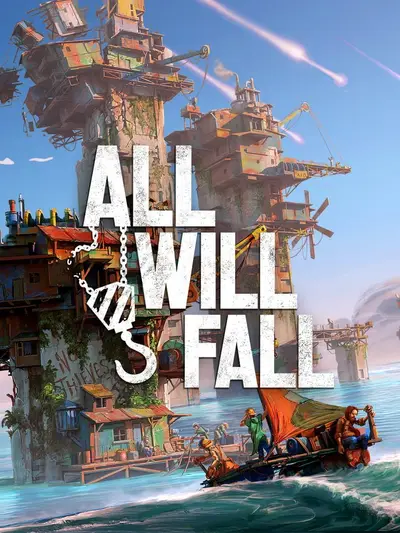
ALL WILL FALL
74Quick answer
Quick answer
ALL WILL FALL is een slimme, eigenzinnige citybuilder die vooral scoort met zijn setting, scenario-opzet en de constante druk van een wereld die nooit helemaal stabiel voelt. De physics-haak is minder dominant dan de titel doet vermoeden, maar de mix van bouwen, overleven en experimenteren blijft sterk genoeg om je lang vast te houden.
De score weerspiegelt een overtuigende mix van sfeer, systemen en scenario’s, met genoeg kanttekeningen om net onder het topsegment te blijven.
A flooded world with a strong identity
ALL WILL FALL makes an immediate impression with its premise: a post-apocalyptic civilization clinging to a drowned world, building cities not on solid ground but above, within, and against the water. That alone gives the game a distinct identity. While many city-builders lean on familiar grids, efficiency, and predictable expansion, this one drops you into a world that feels unstable by design. That instability suits the atmosphere perfectly. You are not constructing a utopia; you are negotiating a fragile balance between ambition, scarcity, and a world that keeps pushing back.
The game’s greatest strength is that this setting is not just dressing. It shapes how you think about space, logistics, and risk. Every expansion feels like a decision with consequences, and even when the game is not as punishing as some of its clearest inspirations, there is still enough tension to make your choices matter. The result is a city-builder that is less about comfort and more about improvisation. You are not trying to perfect an ideal city so much as keep a fragile system from collapsing under its own weight.
Building with tension, not just efficiency
The construction systems are the heart of the experience, and they are where ALL WILL FALL is at its most charming. The game encourages you to experiment with vertical structures, limited room, and an environment that does not always cooperate. That makes designing a settlement more interesting than simply optimizing the best production chain. You are not just watching output numbers; you are thinking about stability, access, and whether your city can actually support itself over time.
That is where the game finds some of its best moments: when a seemingly smart expansion creates a new problem somewhere else. An extra platform might speed up production, but it can also disrupt flow or leave you vulnerable to a chain reaction when conditions worsen. Even when the game is not punishing you every minute, there is a steady undercurrent of tension. Every change to the city feels structural, not cosmetic.
That said, expectations matter here. The physics layer is not constantly a brutal, all-defining force that tears apart every plan. At times it feels more like a smart layer on top of a traditional city-builder than a complete reinvention of the genre. That is not necessarily a flaw, because it keeps the game more approachable and less frustrating than the harshest survival builders. But if you are hoping for a fully chaotic construction sim where every piece dramatically reacts to the world, you may find the promise is bigger than the implementation.
Logistics, production, and the art of thinking ahead
Where ALL WILL FALL gains a lot of ground is in how it connects its systems. Resources, production, population, and political decisions are not isolated mechanics; they constantly force you to think ahead. The game creates a satisfying push and pull between short-term survival and long-term planning: today you need food and security, tomorrow your city still needs to be standing. That gives both the campaign and the scenario structure a strong rhythm.
Logistics is more than an administrative layer here. Because you are building in an unstable, waterlogged world, the question of where something goes suddenly matters a great deal. An efficient route is not just convenient; it can be the difference between a functioning settlement and a city that jams itself into failure. That keeps production and supply from feeling routine. You are constantly weighing risk, space, and capacity, and that keeps your attention locked in.
The population layer adds to that pressure as well. Your people are not just abstract numbers to be increased; they are another source of strain on a system already under stress. That makes the experience feel a little more personal than many city-builders do. You are not building for growth alone, but for survival, and that shift is felt in the way your priorities change as conditions worsen.
Scenarios that encourage experimentation
The scenario structure helps the game enormously. Rather than relying on one sprawling sandbox that slowly settles into routine, ALL WILL FALL offers different situations that emphasize different pressures. That keeps the experience fresh and makes experimentation worthwhile. One setup may demand compact efficiency, another may push flexibility or a different approach to scarce resources. The result is a game that keeps asking you to solve the same broad problem in new ways.
That variety is important because it significantly improves replay value. You can return with a different mindset and discover that the same core mechanics produce very different outcomes. That is exactly the kind of design that keeps a strategy game alive for a long time. The sandbox-style options benefit from this too, because the game is not just about checking off objectives, but about discovering what is possible inside an unusual world.
The scenarios also help pace the tension. Instead of an endless build-up that gradually turns into habit, you get compact challenges where pressure arrives faster and more clearly. That makes the game more approachable for players who like a defined focus, while still appealing to those who enjoy testing systems and refining their approach.
A presentation that sells the world
Visually, ALL WILL FALL has a clear style that fits its theme well. The cities look compact, vulnerable, and mechanical, while the environment constantly reminds you that you are building in a hostile place. The game communicates its world through shape and function: you can read how a structure works, why it is holding together, and where it might fail. That makes your own city easy to understand at a glance, which matters in a game with this many moving parts.
That readability is crucial, because the game often asks for quick decisions. You need to see at a glance where the bottlenecks are, which parts of your city are under pressure, and where expansion is still safe. The presentation supports that well. The game does not rely on excess, but on a functional aesthetic that emphasizes fragility and structure. As a result, the world feels believable without getting in the way of the strategy.
The audio and thematic presentation also do enough to maintain the right mood. There is a steady sense of scarcity and pressure throughout the experience, but the game never becomes so grim that it feels oppressive. That is a smart balance. ALL WILL FALL wants to challenge you, not crush you. That makes it inviting enough that you will want to try another scenario, redesign another city, or fix another logistical mistake.
Where it falls a little short
The main criticism is that ALL WILL FALL sometimes does less than its concept suggests. The title promises a world where collapse and physics are central, but in practice that element is often an interesting factor rather than a constant threat. As a result, the game occasionally misses the extra layer of panic or spectacle that could have made it truly unforgettable. You can feel that you are building on unstable ground, but not always that every moment is on the verge of disaster.
The political and societal systems are present and useful, but they are not always sharp enough to linger in the memory once the building puzzle gets going. They add tension and give your choices meaning, yet they do not always bite as hard as the best genre peers. That leaves the game feeling a little less urgent than it could have been. It is less intense, but also slightly less distinctive in the way it builds pressure.
That is a shame, but not a deal-breaker. The combination of smart scenarios, strong atmosphere, and solid systems covers a lot of that ground. ALL WILL FALL is not the most radical city-builder of recent years, but it is one of the more interesting ones. It clearly knows what it wants to be, even if it does not fully realize every part of its own promise.
Conclusion: a strong, idiosyncratic strategy game
ALL WILL FALL is a strong and idiosyncratic strategy game that does more than cash in on a gimmick. The setting is memorable, the building feels meaningful, and the scenario structure makes experimentation worthwhile. The game finds a pleasing balance between tension and accessibility, between improvisation and planning, and between atmosphere and readability.
Not everything falls as hard as the title suggests, but enough of it stands firmly to support a long and enjoyable session. For players who like city-builders with a clear identity, an interesting logistics layer, and enough variation to keep them coming back, this is a particularly satisfying find. It is not a perfect reinvention of the genre, but it is a convincing and often clever twist on it.
Verdict
ALL WILL FALL is een sterke, eigenzinnige citybuilder die meer goed doet dan hij misleidt, ook al komt niet elke belofte even hard binnen.
At a glance
Pros
- Sterke, herkenbare setting met veel sfeer
- Slimme scenario-opzet die experimenteren beloont
- Bouwen en logistiek voelen betekenisvol en spannend
- Goede herhaalwaarde door verschillende speelstijlen
Cons
- De physics-haak is minder dominant dan de titel belooft
- Sommige systemen missen net de scherpte of urgentie van de beste genrevoorbeelden
Screenshots
More reviews
Other recent game reviews on GAME-scanner.
There are no other reviews to show yet.