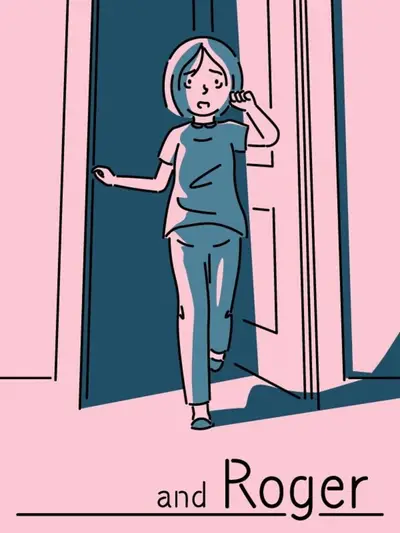
and Roger
87Quick answer
Quick answer
and Roger is een korte maar intens persoonlijke ervaring die zijn thema’s opvallend direct en menselijk overbrengt. Ik vond vooral de combinatie van eenvoudige interactie en emotionele impact sterk, al had ik soms meer speelruimte en minder nadrukkelijke sturing gewild.
Mijn score weerspiegelt een uitzonderlijk sterke korte ervaring met minimale maar merkbare kanttekeningen in vrijheid en mechanische diepgang.
A small game with a heavy emotional load
What stood out to me immediately about and Roger is how little it needs to leave an impression. In my time with it on Nintendo Switch 2, it never felt like a game trying to wow me with scale or systems. Instead, it felt carefully built around a very specific emotional idea, and that focus gave it a surprising amount of weight. It starts almost disarmingly plain: I click, I observe, I follow the logic of a world that feels slightly off. Because the game is so restrained at first, the emotional undercurrent hit me even harder later on.
The premise is unsettling right away. I quickly sensed that Sofia’s reality is not stable, and the game uses that instability well. It doesn’t drown me in exposition; it lets small shifts in behavior, language, and interaction do the work. I found that effective because I was constantly trying to judge what I was seeing, what I thought I understood, and what the game might be withholding on purpose. That tension is never loud or flashy, but it is persistent and very effective. I was always just a little unsure, and that uncertainty became part of the experience rather than a flaw.
Interaction that serves the story
The heart of the experience is the way gameplay and narrative are fused together. Many actions are simple, almost mundane, but in this context they gain real meaning. I was impressed by how a small minigame-like moment could suddenly say something about confusion, routine, or dependence. Those details made the difference for me between a story I merely followed and a story I actually experienced. I kept noticing how the game could make an ordinary action feel emotionally loaded just by changing the context around it.
On Switch 2, the handheld presentation worked especially well. I played most of it in portable mode, and the smaller screen suited the game’s focused design. I never felt like I was wrestling with a cluttered interface or unnecessary distractions. The controls are straightforward but purposeful, and I rarely felt like the game was fighting me. At the same time, I did notice that it wants to guide me so closely that I sometimes wished for a little more room to explore or connect the dots on my own. That tension between clarity and freedom is one of the game’s defining traits.
That’s one of the central tensions in my verdict. I really appreciate the clarity of the design, but I also felt the game occasionally plays it safe in the interaction department. The puzzle elements are smart enough to support the theme, yet they are rarely complex enough to stand out as puzzles on their own. For me, that usually worked in the game’s favor, though I did want a bit more mechanical layering at times. I could feel the intention behind every interaction, but I also felt the limits of how far the mechanics were willing to go.
Pacing, structure, and emotional precision
The short runtime is both a strength and a limitation. I was through it fairly quickly, and in this case I think that was the right call. The game doesn’t stretch its core idea beyond its limits, and I appreciated that it stays deliberately compact. There’s clear pacing discipline here: little filler, few detours, and a sharp emotional focus throughout. In my view, that’s a big part of why it lingers after the end. I finished it feeling like nothing essential had been wasted.
Still, the brevity comes with a trade-off. There were moments when I wanted a little more development in the relationships or the world around them. Not because the game feels empty, but because its themes are strong enough to support another layer. I found the overt direction to be a minor drawback in particular: the game knows exactly what it wants to say, but it sometimes leaves very little air between the lines. That made it feel less subtle than it could have been. I understood the intent, but I occasionally wished the game trusted me a little more to sit with ambiguity.
Even so, the emotional precision is hard to deny. Several times during my playthrough, I felt the game land on a feeling or idea with real accuracy without overexplaining itself. The blend of confusion, care, grief, and small flashes of humanity stayed with me. Because the game doesn’t try to explain everything, it leaves room for interpretation and empathy, and that restraint is a big part of its power. I found myself thinking back to specific moments long after I had stopped playing.
Perspective and thematic force
What makes and Roger especially memorable to me is its perspective. The game doesn’t talk about dementia from a distance; it places me inside Sofia’s experience and lets the world become unstable through her eyes. I found that impressive because it does something many stories about this subject avoid: it doesn’t just explain what is going wrong, it makes the confusion itself legible. In my sessions, small changes in language and behavior were enough to create a strong sense of disorientation. That is not only smart writing, but careful design.
I also appreciated how the game makes room for hope. It is not a relentlessly bleak experience. There are small flashes of warmth and humanity that make the emotional impact stronger, not weaker. Those contrasts keep the story from becoming one-note. I liked that the game doesn’t focus only on loss; it also emphasizes care, love, and the stubbornness of connection. That balance matters, because it makes the sadness feel earned rather than manipulative.
The result is a game that stays with you because it keeps asking you to feel and interpret at the same time. I never got the sense that it was using its subject matter as decoration. It is the core of the whole experience, and the game is stronger for that commitment. I came away thinking less about individual plot points and more about the emotional logic of the whole thing.
Presentation and atmosphere
Visually and aurally, and Roger goes for a restrained approach that suits the material. I wouldn’t call the presentation flashy, but I do think it is tuned precisely to the game’s atmosphere. The style helps convey unease and fragility without pulling attention away from the core idea. The sound design also supports that mood subtly; I found that small noises and moments of silence often did more than a big musical swell would have done. In several scenes, the quiet was more unsettling than any dramatic cue could have been.
What stayed with me most is how consistent the tone is. There’s very little ornamentation, very little irony, and no real attempt to hide the emotional core behind cynicism. I found that refreshing, even if the directness may feel a bit moralizing or heavy-handed to some. For me, it worked because the game feels sincere and deliberate. I got the sense that every part of it — interaction, pacing, presentation — was in service of the same message. That consistency gives the game a strong identity.
The Switch 2 version also benefits from being played handheld. The compact design, calm interface, and short sessions fit the platform beautifully. I didn’t want to marathon this game; I wanted to absorb it in concentrated bursts, and that is exactly how it works best. In that format, the atmosphere lands cleanly and the emotional beats have room to settle.
My verdict
and Roger is not a broad-appeal game in the traditional sense, but it is an exceptionally well-executed short experience. I appreciate the courage it takes to make a difficult subject tangible through play, and I found the Switch 2 version strong enough to make the simplicity feel intentional rather than limited. My main criticism remains that the game sometimes pushes its hand too visibly and leaves a bit too little mechanical space, but that doesn’t outweigh its emotional and thematic force for me. I would have welcomed a little more room to experiment, yet I can’t deny how effectively the game communicates what it wants to say.
This is a compact, sensitive, and memorable title that stays with you long after the credits roll. I came away from it feeling like I had spent time inside someone else’s uncertainty, and that is not something many games manage to do with this much clarity. For me, and Roger is small in scope but large in impact.
Verdict
Een kleine game met grote zeggingskracht, al had ik iets meer mechanische ruimte gewild.
Frequently asked questions
Is and Roger de moeite waard?
Ja, vooral als je openstaat voor korte, verhalende games met een sterk emotioneel en thematisch doel. De ervaring is compact, maar de combinatie van verhaal en interactie maakt veel indruk. Wie vooral diepgaande puzzels of veel speeluren zoekt, zal minder krijgen dan bij een traditionele adventure.
Hoe lang duurt and Roger?
De game is kort en is in ongeveer een uur tot enkele uren te doorlopen, afhankelijk van tempo en aandacht. De compacte duur is duidelijk onderdeel van het ontwerp. Daardoor voelt het meer als een intens verhaal dan als een lange campagne.
Is and Roger geschikt voor handheld spelen?
Ja, de game past goed bij handheld spelen. De interface en het rustige tempo werken prettig op een kleiner scherm. Op Nintendo Switch 2 komt die focus extra goed tot zijn recht.
Hoe moeilijk is and Roger?
De uitdaging zit minder in zware puzzels en meer in het begrijpen van de situatie en de betekenis van de interacties. Het spel is toegankelijk qua besturing en structuur. De moeilijkheid is dus vooral mentaal en emotioneel, niet technisch.
Vergelijkbare games?
Het ligt het dichtst bij korte narratieve indiegames die verhaal en simpele interactie combineren. Wie houdt van intieme, thematische ervaringen met een duidelijke auteursstem, zit hier goed. Verwacht geen grote sandbox of complexe systems-driven gameplay.
At a glance
Pros
- Sterke emotionele impact in een compacte vorm
- Slimme koppeling tussen interactie en thema
- Werkt uitstekend in handheld op Switch 2
Cons
- Soms wat te nadrukkelijk in zijn sturing
- Mechanisch eenvoudiger dan de thematiek verdient
Screenshots
More reviews
Other recent game reviews on GAME-scanner.
There are no other reviews to show yet.