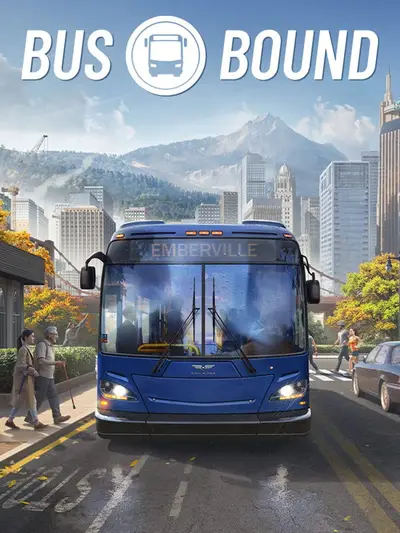
Bus Bound
74Quick answer
Quick answer
Bus Bound is een toegankelijke en verrassend doelgerichte bus-sim die vooral uitblinkt door de combinatie van rijden, routes beheren en Emberville stap voor stap zien veranderen. De game is minder diep dan hardcore simfans misschien hopen, maar de sfeer, variatie in bussen en het gevoel van vooruitgang maken veel goed. Het resultaat is een prettige, compacte simulator met duidelijke charme en enkele zichtbare beperkingen.
Ik geef Bus Bound een 74 omdat de toegankelijke kern, de stadsgroei en de sfeer duidelijk sterker zijn dan de beperkingen in diepgang en technische rafelrandjes.
Bus Bound is the kind of simulation game that understands the appeal of a clear, well-executed routine. It does not try to overwhelm you with a mountain of systems or bury its identity under layers of realism for realism’s sake. Instead, it focuses on a simple but satisfying fantasy: you are a bus driver in Emberville, and your job matters. You pick up passengers, stay on schedule, navigate traffic, and help shape a city that is slowly becoming more pedestrian-friendly because of the work you do. That premise gives the game a stronger sense of purpose than many genre peers, and it is the reason Bus Bound feels welcoming from the very first route.
What makes that approach work is how confidently the game commits to it. Bus Bound knows it is not trying to be the most punishing or intricate simulator on the market. It wants to be approachable, readable, and rewarding in a way that does not require a manual to appreciate. That decision will not satisfy everyone, especially players who want every switch, gauge, and procedure modeled in painstaking detail. But for anyone looking for a simulation game that is easy to settle into without feeling shallow, Bus Bound makes a strong case for itself.
Driving that feels grounded, not exhausting
The heart of Bus Bound is the act of driving, and the game gets that part right. Each bus has enough weight and personality to make the experience feel grounded, but not so much that every turn becomes a chore. The handling strikes a careful balance between realism and comfort. You need to pay attention, brake properly, and respect the road, yet the game never seems interested in punishing you for not being a professional driver in real life. That makes it far easier to enjoy the rhythm of the job.
That rhythm is one of the game’s biggest strengths. There is something inherently satisfying about pulling into a stop, opening the doors, watching passengers board, and then easing back into traffic with the next destination in mind. Bus Bound turns those small actions into a loop that feels calm but purposeful. It is not flashy, and it does not need to be. The pleasure comes from doing ordinary tasks well and seeing them add up to something larger.
This is also where the game’s accessibility matters most. Bus Bound is clearly designed to be approachable for players who might otherwise bounce off a more demanding sim. It asks for care and attention, but not mastery. That makes it a good entry point for the genre, while still offering enough texture to keep the driving from feeling completely automatic.
Emberville gives the journey meaning
Many simulation games are content to let you repeat a task because the task itself is the point. Bus Bound goes a step further by giving that repetition a visible impact on the world. Emberville is not just a backdrop for routes; it is a city that changes as you play. Helping transform it into a more pedestrian-friendly place gives every shift a sense of direction. You are not simply moving people around for the sake of efficiency. You are contributing to a broader civic project.
That idea gives the game a warm, almost optimistic tone. There is a quiet satisfaction in seeing the city respond to your efforts, and that response becomes the reward that keeps you coming back. Progress is not just about unlocking the next bus or completing another route. It is about watching Emberville become more alive, more coherent, and more shaped by your presence. That is a subtle but powerful motivator, and it helps Bus Bound stand out from transport sims that feel more mechanical than meaningful.
The result is a game with a clear emotional center. It is still a simulation, but it is one with a purpose beyond efficiency. That purpose makes even routine trips feel like part of a larger story, and it gives the game a sense of charm that is easy to appreciate.
Variety, weather, and a lived-in atmosphere
Bus Bound keeps its routes from blending together by leaning on a few well-chosen variables. Different buses handle differently enough to matter, which gives you a reason to adjust your approach rather than simply repeating the same motions. That variety is not dramatic, but it is enough to keep the driving fresh over time. It also reinforces the idea that you are working with a fleet, not just a single vehicle.
The weather system is another smart addition. Rain, reduced visibility, and other changing conditions make familiar streets feel different without altering the game’s core structure. A route that feels routine in clear conditions can become more tense and atmospheric when the weather turns. These are the kinds of details that do a lot of heavy lifting in a simulation game. They do not need to be spectacular to be effective; they just need to make the world feel responsive, and Bus Bound does that well.
That responsiveness extends to the overall mood of the game. There is a pleasant warmth to the experience, a sense that you are part of a functioning city rather than just passing through it. The game’s atmosphere is not loud or dramatic, but it is consistent. That consistency helps Bus Bound feel comfortable to return to, even when the gameplay loop itself remains fairly modest.
Accessibility comes with limits
The trade-off for all that accessibility is depth. Bus Bound is intentionally not a hardcore simulation, and that will be a dealbreaker for some players. If you want a game that models every possible manual process or lets you dig into highly specific operational details, this is not that game. It stays focused on the essentials, and while that keeps the experience clean and approachable, it also means there is less mechanical complexity to discover over time.
That limitation becomes more noticeable the longer you play. The core loop is solid, but it is also narrow enough that repetition eventually creeps in. Driving, stopping, boarding passengers, and repeating the process is satisfying for a while, especially when the city progression is still unfolding. But once the novelty of the routes wears off, the game does not always have enough systemic depth to keep every session feeling distinct. It is a game that works best when you appreciate its pace rather than when you expect constant escalation.
That is not a flaw in the abstract, but it does define the audience. Bus Bound is for players who want a welcoming transport sim with a clear goal and a gentle learning curve. It is less suited to those who want a dense, highly technical sandbox. Knowing which side of that divide you fall on will probably determine how much you enjoy it.
Technical rough edges
There are also some technical and animation issues that keep Bus Bound from feeling fully polished. They are not constant enough to ruin the experience, but they are noticeable. In a game built around immersion, routine, and smooth movement through a city, even small hiccups can stand out more than they would in a louder or more chaotic title. A slightly awkward animation or a bug that interrupts the flow can briefly break the spell.
Fortunately, these issues are more distracting than damaging. They do not erase the game’s strengths, but they do prevent it from feeling as seamless as it could have been. Given how strong the underlying concept is, it is easy to imagine Bus Bound benefiting from a bit more technical refinement. The foundation is solid; it just occasionally shows its seams.
Final thoughts
Bus Bound is a charming, accessible simulation game with a clear identity and a satisfying sense of purpose. It succeeds by making the simple act of driving a bus feel meaningful, and by tying that work to a city that visibly changes as you play. Emberville gives the game a strong motivational hook, while the variety in buses and weather keeps the routes from becoming too uniform too quickly.
Its limitations are just as clear. The simulation is intentionally light, the repetition eventually shows, and a few technical issues keep the experience from feeling completely polished. Even so, Bus Bound is easy to recommend to players who want a friendly, low-stress transport sim with a warm atmosphere and a rewarding progression loop. It may not be the deepest ride on the road, but it is a very pleasant one.
Verdict
Bus Bound is geen revolutionaire sim, maar wel een charmante en doordachte rit die precies weet waar zijn kracht ligt.
At a glance
Pros
- Toegankelijke besturing en een prettige ritmiek in het rijden.
- Emberville geeft progressie een duidelijke, motiverende betekenis.
- Variatie in bussen en weersomstandigheden houdt ritten levendig.
- De game heeft een warme, doelgerichte sfeer.
Cons
- De simulatie blijft bewust vrij simpel en mist echte hardcore-diepte.
- Herhaling en technische/animatieproblemen vallen na verloop van tijd op.
Screenshots
More reviews
Other recent game reviews on GAME-scanner.
There are no other reviews to show yet.