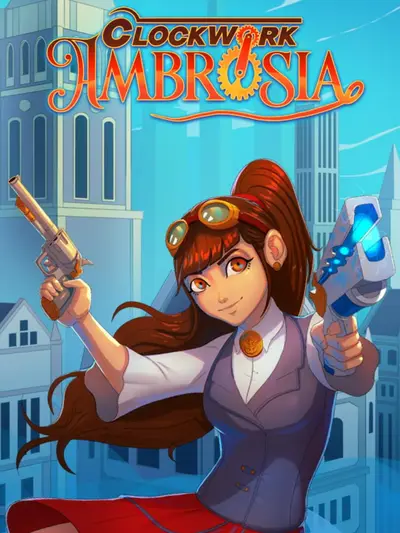
Clockwork Ambrosia
74Quick answer
Quick answer
Clockwork Ambrosia is een sterke metroidvania-shooter met een heerlijk eigen steampunk-smaak en een opvallend diep wapensysteem. De game blinkt uit in experimenteren en ontdekken, maar laat je ook geregeld verdwalen of worstelen met logge bediening en een stroperig tempo.
Sterke sfeer, slimme wapens en solide gevechten tillen Clockwork Ambrosia boven de middenmoot uit, maar de stroefheid en vaagheid houden het net onder echt topniveau.
Clockwork Ambrosia is the kind of indie game that makes a strong first impression and then keeps revealing more of its personality the longer you spend with it. It blends metroidvania exploration, 2D shooting, and steampunk adventure into a single package that feels built around a clear fantasy: piloting through a machine-haunted world, scavenging for upgrades, and turning your weapons into increasingly bizarre tools of destruction. It is not always the smoothest ride, but it is almost always an interesting one.
A world with a strong identity
The first thing Clockwork Ambrosia gets right is atmosphere. This is a steampunk setting that feels lived in rather than simply pasted on. Metal corridors, industrial ruins, mechanical contraptions, and hostile creatures all fit together into a world that feels cohesive and memorable. The game does not rely on generic fantasy shorthand; instead, it builds a distinct visual language around pressure valves, gears, smoke, and rusted machinery. That gives every area a sense of place, even when the structure of the game is asking you to revisit familiar spaces.
That identity matters because the game spends so much time on exploration and backtracking. In a lesser title, the repeated returns through old areas might feel like padding. Here, the setting helps keep those journeys engaging. The world feels like a machine in motion, and each new route you unlock makes the map feel a little more interconnected. It is a classic metroidvania setup, but one that benefits from a strong aesthetic foundation.
Exploration that trusts the player
Clockwork Ambrosia does not hold your hand, and that is both a strength and a limitation. The game expects you to remember blocked paths, notice environmental clues, and figure out where your next objective might be without constant guidance. For players who enjoy that old-school approach, it is satisfying. There is real pleasure in realizing that a tool you just acquired opens up a route you passed hours ago, or in slowly piecing together how a new area connects to the larger map.
At the same time, the lack of direction can become frustrating. Some detours feel rewarding, but others feel like you are wandering without much payoff. The game is not always generous with hints, and that can make progress feel slower than it should. The result is a world that invites curiosity, but also occasionally tests patience. If you like being left to your own devices, the structure works well; if you prefer a clearer sense of momentum, it can feel a little too vague.
The weapon mod system is the real star
What truly sets Clockwork Ambrosia apart is its weapon customization. The game encourages you to experiment with modifications, accessories, and loadout changes in a way that feels genuinely meaningful. These are not just flat stat boosts. They alter how your weapons behave, which means a new attachment can change the rhythm of combat and the way you approach specific encounters. That sense of tinkering is one of the game’s biggest pleasures.
When the system clicks, it is easy to get absorbed in testing combinations and seeing how far you can push a build. There is a real thrill in finding a setup that suddenly makes a difficult section feel manageable, or in discovering a weapon configuration that turns a routine fight into something much more chaotic and fun. The game clearly wants you to play around, and it rewards that curiosity with some of its best moments.
Still, the system is not quite as free-form as it first appears. Swapping between weapons can feel sluggish, which interrupts the sense of improvisation the game is aiming for. There is also a sense that a few builds are simply more effective than the rest, which narrows the field a little more than it should. The customization is deep and enjoyable, but it does not always feel as fluid or as open-ended as the concept suggests.
Combat that works best when you stay mobile
Combat in Clockwork Ambrosia is generally strong because it asks you to stay active. Enemies are built to pressure your movement, and fights often involve juggling projectiles, close-range threats, and awkward positioning at the same time. That gives the action a satisfying old-school shooter energy. You are not just standing still and trading damage; you are constantly adjusting, dodging, and trying to keep the battlefield under control.
The game also benefits from the way your weapon choices affect combat flow. A good loadout can make a big difference in how encounters feel, and that adds a light tactical layer to the action. You are encouraged to think about what you are carrying, not just how well you can aim. When the pacing is right, the result is a lively mix of movement and firepower that suits the game’s adventurous tone.
The downside is that the best parts of combat take a while to arrive. Progression can be slow, and it may take too long before the most exciting weapon setups become available. That means the early hours are competent, but not always thrilling. The game is clearly building toward bigger and stranger possibilities, yet it asks you to be patient before it fully pays off.
Pacing, progression, and the cost of backtracking
Like many metroidvania games, Clockwork Ambrosia depends on the balance between discovery and repetition. When that balance is right, backtracking feels purposeful because you are returning with new abilities and a better understanding of the map. When it is off, the same structure can feel like a chore. Here, the game lands somewhere in the middle. There are plenty of satisfying moments of progression, but there are also stretches where the reward for exploration feels modest.
That unevenness is part of why the game can be enjoyable without becoming truly unforgettable. It has enough good ideas to keep you interested, but not always enough momentum to make every section feel essential. The experience is strongest when a new weapon mod or traversal upgrade opens up a fresh layer of the map. It is weaker when you are simply moving through familiar spaces in search of a destination the game has not made clear enough.
Controls and overall feel
One of the most noticeable drawbacks is that the controls do not always feel as smooth as they should. In a game built around precision movement, shooting, and frequent weapon changes, even small bits of awkwardness matter. The result is not a broken experience, but it is a slightly rough one, and that roughness becomes more apparent the longer you play.
That lack of polish does not erase the game’s strengths, but it does keep them from shining as brightly as they could. Clockwork Ambrosia has a strong concept, a memorable setting, and a genuinely fun customization hook. It just does not always deliver those ideas with the speed and fluidity they deserve.
Conclusion
Clockwork Ambrosia is a good metroidvania shooter with a standout weapon-mod system and a world that knows exactly what it wants to be. Its atmosphere is distinctive, its exploration has the right kind of classic structure, and its customization can be a lot of fun when you start pushing it in unusual directions. At the same time, vague navigation, sluggish weapon swapping, and uneven pacing hold it back from greatness.
For players who enjoy methodical exploration, tinkering with builds, and a setting with real personality, it is easy to recommend. If you want constant guidance or especially slick controls, you may find it a little rough around the edges. Either way, Clockwork Ambrosia leaves an impression, and that is often the mark of a game worth noticing.
} 0}]}Verdict
Clockwork Ambrosia is een aanrader voor genrefans die graag bouwen, zoeken en terugkeren, maar het spel vraagt wel om geduld.
At a glance
Pros
- Sterke steampunk-sfeer met een duidelijke eigen identiteit
- Diep en leuk wapensysteem dat experimenteren beloont
- Degelijke mix van verkenning, schieten en terugkeer-structuur
Cons
- Navigatie en richting zijn soms te vaag
- Wisselen en bewegen voelt niet altijd even soepel
Screenshots
More reviews
Other recent game reviews on GAME-scanner.
There are no other reviews to show yet.