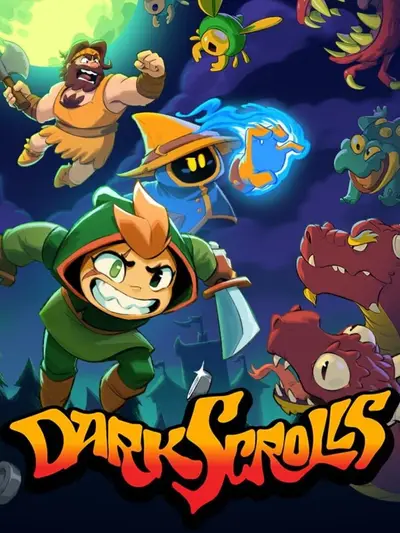
Dark Scrolls
62Quick answer
Quick answer
Dark Scrolls mixt auto-scrolling platformactie, roguelite-opbouw en bullet-hell-chaos in een opvallend charmante retroverpakking. Ik vond de basisideeën sterk en de co-op kan echt leuk zijn, maar de onregelmatige besturing, herhaling en soms zwakke progressie drukken het totaalbeeld.
Ik geef Dark Scrolls een 62 omdat de creatieve basis en co-op echt leuk zijn, maar de zweverige besturing, onevenwichtige progressie en vroege herhaling de game duidelijk afremmen.
Dark Scrolls is the kind of game that immediately made me think, this has a real identity. The blend of auto-scrolling platforming, shmup-style chaos, and roguelite progression sounds messy on paper, yet in my time with it I kept feeling that the developers were aiming for something energetic and unusual rather than safe. I was drawn in by the retro fantasy presentation right away: the pixel art has personality, the animation pops, and the whole thing carries a playful but slightly grim tone that suits the action well. At the same time, I also ran into enough friction to keep it from becoming an easy recommendation.
What stood out to me first was how willing the game is to throw different ideas into the same space. I enjoyed the moments where I had to jump, dodge, and read projectile patterns at the same time, because those sections gave the game a strong arcade rhythm. In my first hours, that mix felt fresh and surprisingly readable, which matters a lot in a game that can get visually busy. I also appreciated the variety in characters and approaches; I never felt like I was simply replaying the same route with a new coat of paint, and that helped the game stay interesting longer than I expected.
Gameplay and pacing
The core of Dark Scrolls is momentum. I was constantly pushed forward, and that gave the action a nice sense of urgency. The auto-scrolling structure keeps the game from lingering, and when it clicks, it creates a satisfying pressure cooker effect where I had to react quickly and commit to decisions. I liked that energy a lot. It gave the game a distinct arcade feel, and some of my best runs came from staying calm while the screen filled with hazards and enemies.
That said, I also felt the controls wobble more than they should in a game built around precision. I ran into several moments where movement felt floaty, especially when I needed to make exact jumps or weave through tight spaces. That looseness is a real problem when the game asks for quick, confident inputs. I also found the level design uneven: there are good ideas here, but I started noticing repetition before the game had fully exhausted its best tricks. In practice, that meant some sections felt more like maintenance than discovery, which blunts the impact of the stronger moments.
Progression and replay value
The roguelite layer gives Dark Scrolls a clear long-term hook. I liked unlocking new characters and seeing how different builds changed my approach from run to run. There is a genuine sense of progression, and it helps the game feel like more than a one-and-done arcade experiment. When the reward loop is working, it gives me a reason to jump back in after a failed attempt and try a different route or setup.
Still, I found the progression balance shaky. Some upgrades made me dramatically stronger, to the point where later stretches lost tension, while other choices felt too minor to matter. That unevenness made the system less satisfying than it could have been, because I was not always making meaningful decisions. I also felt that the game asks for a fair amount of time before it opens up properly. Early on, the reward structure can feel a bit thin, and I needed patience before the more interesting layers started to show themselves. For a roguelite, that is a risky trade-off.
Presentation and co-op
Where Dark Scrolls is most consistently successful is in its presentation. I really liked the pixel art, which is colorful without becoming muddy, and the fantasy atmosphere gives the game a stronger personality than many similarly structured action platformers. The sound design supports the action well, and the overall tone lands somewhere between mischievous and dangerous in a way that suits the gameplay. I also found the cast of characters appealing; even when the mechanics were uneven, the game kept offering enough visual and tonal charm to keep me engaged.
The co-op is a major bright spot. When I played with others, the game became more enjoyable almost immediately, because the chaos felt shared rather than punishing. I had more fun improvising with a partner, and even messy runs turned into memorable sessions. Solo play, by contrast, exposes the rougher edges much more clearly. The repetition, the balance issues, and the occasional control awkwardness all become harder to ignore when there is no second player to help carry the energy.
Critique and final impression
My biggest issue with Dark Scrolls is that its ambition outpaces its polish. I can see the appeal in the concept, and I respect how much variety the game tries to pack into a compact format, but the execution does not always keep up. I did not run into a disaster, and I would not call it broken, but I did spend enough time feeling slightly underwhelmed by the way its systems interact. The game has charm, but charm alone cannot fully compensate for controls that feel a little too loose and a progression curve that is not consistently rewarding.
Even so, I do not think Dark Scrolls is a lost cause at all. I had genuine fun with it in bursts, especially when the action got hectic and the co-op chaos kicked in. For me, it lands as a solid but imperfect indie experiment: inventive, stylish, and worth a look if the genre mix appeals to you, yet not quite sharp enough to rise above its rough edges. I came away respecting what it tries to do more than loving every minute of the execution.
Dark Scrolls is inventive and charming, but its uneven controls and progression keep it in the “good idea, mixed result” zone.
Verdict
Een eigenzinnige en charmante mix die vaak werkt, maar niet altijd strak genoeg is om echt te schitteren.
Frequently asked questions
Is Dark Scrolls de moeite waard?
Dark Scrolls is vooral de moeite waard als de mix van auto-scrolling actie, roguelite-opbouw en co-op je aanspreekt. De game heeft veel charme en een duidelijke eigen stijl, maar de uitvoering is niet overal even strak. Solo is het minder sterk dan met meerdere spelers.
Hoe lang duurt Dark Scrolls?
De totale speeltijd hangt sterk af van hoeveel je wilt vrijspelen en hoe vaak je runs opnieuw probeert. De game is gebouwd rond herhaling en progressie, dus de inhoud strekt zich vooral uit via replay value in plaats van een lange lineaire campagne.
Heeft Dark Scrolls co-op?
Ja, co-op is een belangrijk onderdeel van de ervaring. In de praktijk komt de chaos dan beter tot zijn recht en voelt de game levendiger aan dan solo. Het is een van de sterkste redenen om de game te spelen.
Is Dark Scrolls moeilijk?
De game vraagt om snelle reacties en een goed gevoel voor timing, maar de moeilijkheid is niet constant even streng. Sommige runs voelen relatief mild aan, terwijl andere juist rommelig en druk worden door de combinatie van scrolling, vijanden en projectielen.
Op welk platform speelt Dark Scrolls het best?
De game is op PC beschikbaar en komt ook naar Nintendo Switch. Op PC is de besturing doorgaans het meest direct, wat goed past bij de precieze actie. De handheld-achtige opzet van de Switch kan aantrekkelijk zijn voor korte sessies.
At a glance
Pros
- Sterke pixelart en een sfeervolle retrofantasy-uitstraling
- De mix van platformactie, shmup-chaos en roguelite geeft de game een eigen identiteit
- Co-op maakt de actie merkbaar leuker en dynamischer
- Veel variatie in personages en speelstijlen
Cons
- Besturing voelt soms te zweverig voor precieze platformsecties
- Progressie en balans zijn onregelmatig, waardoor sommige keuzes te sterk of te zwak aanvoelen
- Herhaling sluipt relatief vroeg binnen
- Solo is de game duidelijk minder overtuigend dan in co-op
Screenshots
More reviews
Other recent game reviews on GAME-scanner.
There are no other reviews to show yet.