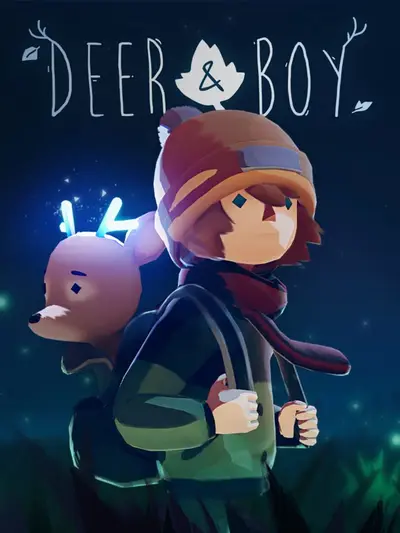
Deer & Boy
74Quick answer
Quick answer
Deer & Boy is een stille, sfeervolle platformadventure die vooral uitblinkt in presentatie en emotie. Ik vond de reis tussen jongen en hert vaak ontroerend, al blijft de puzzelwerking bewust simpel en soms wat stroef in de besturing. Het resultaat is een kort maar memorabel avontuur met duidelijke charme.
Deer & Boy scoort een 74 omdat de presentatie, sfeer en emotionele kern sterk zijn, terwijl de puzzels en besturing net te licht en wisselvallig blijven voor een hogere trede.
A quiet journey that makes an immediate impression
Deer & Boy made a strong impression on me very early on. In my time with it on Xbox Series X|S, it felt like stepping into a small, carefully crafted fairy tale that leans on mood, timing, and detail rather than spectacle. What stood out to me most is how confident the game is in its silence: there’s no heavy-handed exposition, no cluttered interface trying to steer me every second, and no constant chatter pulling me out of the world. I had to pay attention to the environment, to the way scenes shifted, and to the relationship between the boy and the deer as it developed without words.
That approach works better than I expected. I found myself playing more attentively than I usually do in a platform adventure, simply because Deer & Boy keeps asking me to read the space around me. A small movement from the deer, a subtle reaction from the boy, a change in lighting or background composition: those little things add up to a journey that carries real emotional weight. I appreciated how much the game trusts me to understand what it is doing without spelling everything out.
What also struck me early is how quickly the game establishes its tone. I didn’t have to sit through long tutorials or a barrage of systems before the experience clicked. Within a short time, I was already in the rhythm of observing, moving, solving, and, most importantly, feeling. That makes Deer & Boy immediately approachable, even though it never really holds your hand. I liked that balance a lot: it feels welcoming without becoming over-explanatory.
Gameplay and puzzles: simple, but often effective
The core loop blends platforming, environmental puzzles, and cooperation between the two leads. I liked that the game never tries to bury me under a complicated move set or a long list of mechanics. Instead, Deer & Boy builds gradually, with puzzles that usually revolve around positioning, timing, and using the deer’s traits in smart ways. In my playthrough, that never felt overly technical; it felt more like a game that wants me to observe, experiment, and understand the rhythm of each scene.
That has clear strengths. I rarely got stuck for long, and I often felt like the spaces were readable in a satisfying way. At the same time, I did notice that the puzzles are not especially deep. Some solutions reveal themselves quickly, which can drain a bit of tension from the experience. I wouldn’t call that a deal-breaker, but it does mean the game can feel a little too restrained at times. If you come in expecting a particularly demanding puzzle platformer, Deer & Boy may feel lighter than you hoped.
Even so, I kept moving because the game knows how to vary its pacing just enough to stay engaging. I especially liked the moments where it briefly shifts tone and asks me to look at a familiar setup from a different angle. That’s where the design feels smartest to me: not in complexity for its own sake, but in how it uses simple systems to support emotion and momentum. I found that I was less interested in “beating” the puzzles than in seeing how each one fit into the larger emotional flow.
That doesn’t mean the puzzles lack satisfaction. Quite the opposite: because the game doesn’t overcomplicate things, a successful solution often feels clean and natural. I had several moments where I felt like I wasn’t executing a trick, but genuinely reading a space and understanding it. For this kind of cinematic platformer, that is a strong design choice, even if I personally would have welcomed a few more ambitious challenges to raise the stakes.
Controls, pacing, and a bit of friction
Not everything feels perfectly polished. I noticed that the controls can be a little loose at times, especially when the game asks for precise movement or a quick reaction. It’s not a constant problem, but it is noticeable. In a few sections, the deer’s movement felt slightly heavy, and that pulled me out of the flow for a moment. Because the rest of the experience is so focused on atmosphere and concentration, those rough edges stand out more than they otherwise might.
The pacing is also a deliberate choice that won’t suit everyone. I often enjoyed the calm build-up, but there were stretches where the game stayed in the same rhythm a little too long. In those moments, I wanted a sharper mechanical peak or a more dramatic twist. Deer & Boy is at its best when the quiet tone is paired with a strong visual beat or an emotional payoff; when that doesn’t happen, the underlying simplicity becomes more obvious.
Still, I never found it boring. The presentation carries a lot of weight, and the central bond between the two characters is strong enough to keep me invested even through the less exciting passages. That relationship is the game’s anchor, and it does a lot of heavy lifting in a good way. I also appreciated that the friction never overwhelms the whole experience; it’s more of a reminder that the game could have been a touch tighter, not a flaw that breaks the journey.
In practice, I just had to be a little more patient with it than I expected. That extra patience fit the game’s mood better than I initially thought it would. The movement may not be silky smooth, but it rarely becomes a serious obstacle, and the emotional tone helps soften the rougher edges.
Presentation: the real star of the show
Visually, Deer & Boy is exactly the kind of game I like to see in this genre. The art direction has a soft, storybook quality, but it also uses contrast and composition well enough to give the world real presence. I found the environments consistently beautiful, with a strong sense of color, silhouette, and motion. This is not a game that shouts for attention; it slowly pulls you in. I kept pausing just to take in a background or animation because the whole thing feels so carefully assembled.
The audio design is just as important. I thought the music and sound effects did a lot to support the mood, and the game uses silence very effectively. Sound here is not just decoration; it helps shape the emotional timing of scenes. Small ambient details, the pause between moments, and the way the score swells at the right time all give the journey extra meaning. For me, that elevates the entire experience quite a bit. There were moments when the combination of image and sound landed so cleanly that I just sat with it for a second before moving on.
What impressed me most is how consistent the presentation remains. The game has a clear visual identity and sticks to it with confidence. Nothing feels accidental. From the smallest animation to the broadest background composition, everything seems designed to support the same emotional line. That cohesion is a big reason why the presentation is the strongest part of Deer & Boy for me.
Story and emotion without dialogue
Deer & Boy tells its story without dialogue, and I thought that was one of its boldest and best choices. I never felt like I was waiting for the game to explain itself in text or voiceover. Instead, I read emotion through body language, distance, closeness, and the way the world responds to the two leads. That makes the experience feel more intimate than many other platform adventures I’ve played.
The bond between the boy and the deer is the real engine here. I felt that relationship grow through small gestures and through the way the game keeps asking me to invest in their cooperation. It works because it feels sincere rather than manipulative. I found myself genuinely wanting both characters to make it through, and that kind of emotional buy-in is exactly what this game is aiming for.
At the same time, the world remains somewhat mysterious. I didn’t mind that, but I did notice it. The game clearly prefers atmosphere over explanation, so some elements feel more like mood than hard lore. Personally, I would have welcomed a little more context in a few places, but I also respect the choice to leave room for interpretation. The result is a story I didn’t just follow; I actively filled in the gaps myself.
That ambiguity gives the journey a fairy-tale quality that fits the rest of the game beautifully. I came away with specific emotional moments rather than a neatly explained mythology, and for this kind of experience, that felt right. The silence is not empty here; it is part of the storytelling.
My verdict
Deer & Boy is a successful cinematic platformer that stands out most through atmosphere, presentation, and emotional cohesion. I didn’t play it for intricate puzzles alone; I played it because I wanted to see how this journey would unfold, and on that level it often lands beautifully. At the same time, it remains a fairly simple game, with a few rough edges in movement and a puzzle design that doesn’t always push far enough. But the core is strong, the relationship between the leads works, and the presentation lingers long after the credits would have rolled.
If you’re open to a short, quiet, carefully made experience, Deer & Boy is absolutely worth your time. I came away feeling like I had played something small but sincere, and that’s exactly the kind of impression this game aims to leave. I’d especially recommend it to anyone who values mood, visual storytelling, and a gentle emotional arc over mechanical complexity.
For me, Deer & Boy is the kind of game that doesn’t need to be huge to be memorable. It knows what it wants to say, says it with confidence, and leaves a lasting impression because of that restraint. I can forgive its lighter puzzles and occasional stiffness because the overall journey feels so carefully shaped.
Final thoughts
What I take away most is not a checklist of mechanics, but the feeling of having moved through a beautifully made, emotionally honest world. I had a few reservations, sure, but I also had several moments where the game’s art, sound, and quiet storytelling came together in a way that genuinely stayed with me. That’s a strong result for any game, and especially for one this understated.
Verdict
Een klein maar oprecht avontuur dat vooral schittert door sfeer en emotie.
Frequently asked questions
Is Deer & Boy de moeite waard?
Ja, vooral als je houdt van korte, sfeervolle platformadventures met een sterke emotionele insteek. De game leunt meer op presentatie en beleving dan op complexe puzzels, dus die aanpak moet je liggen.
Hoe lang duurt Deer & Boy?
De game lijkt compact en is eerder een korte, verhalende ervaring dan een lange campaign. De totale speeltijd hangt af van hoe snel je door de puzzels gaat en hoeveel je stil blijft staan bij de omgeving.
Is de game moeilijk?
De puzzels zijn meestal toegankelijk en vragen vooral observatie en timing. De uitdaging zit eerder in het lezen van de omgeving dan in het beheersen van ingewikkelde systemen.
Is Deer & Boy geschikt voor handheld spelen?
Ja, de rustige opzet en korte sessies passen goed bij handheld gebruik. Wel kunnen de wat subtiele visuele aanwijzingen en lichte besturingsfrictie op een kleiner scherm extra opvallen.
Vergelijkbare games?
De game sluit aan bij andere cinematic platformers met een focus op sfeer, puzzels en zonder veel dialoog. Als je daarvan houdt, is dit een logische volgende stap.
At a glance
Pros
- Prachtige art direction en sterke sfeer
- Ontroerende band tussen jongen en hert
- Muziek en sound design versterken elke scène
Cons
- Puzzels blijven vaak vrij eenvoudig
- Besturing en beweging voelen soms wat log
Screenshots
More reviews
Other recent game reviews on GAME-scanner.
There are no other reviews to show yet.