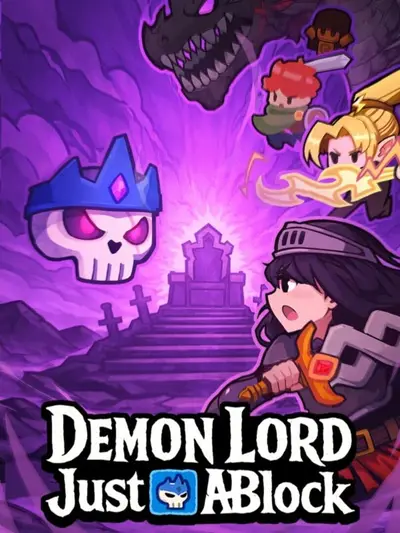
Demon Lord: Just A Block
74Quick answer
Quick answer
Demon Lord: Just A Block is a smart roguelite built around one strong idea: the world only moves when you do. That creates a tactical, almost hypnotic flow where planning, reacting, and taking risks constantly feed into each other. It is small in scope, but often surprisingly addictive.
74/100 — strong design and an addictive flow lift it above the pack, though balance and presentation keep it just shy of the top tier.
Demon Lord: Just A Block is the kind of indie game that proves a single, well-executed idea can carry an entire experience. The premise is deceptively simple: you move in blocks, the world only advances when you do, and every collision can become an attack, a mistake, or a carefully set trap. That rule gives the game a distinct identity from the start, turning each room into a compact tactical puzzle where spacing, timing, and route planning matter more than raw speed.
What makes the game stand out immediately is how completely it commits to that idea. Nothing about the design feels half-hearted or decorative; almost every system seems built to reinforce the same core loop. As a result, the game creates a pace that is both calm and tense. You are always thinking ahead, but you are also always aware that one wrong step can change the entire rhythm of a run. That balance is what gives Demon Lord: Just A Block its appeal: it is deliberate without becoming sluggish, and reactive without becoming chaotic.
A roguelite built around deliberate movement
The most impressive thing about Demon Lord: Just A Block is how fully it embraces its movement system. Because the world only progresses in response to your actions, you are constantly deciding not just where to go, but when to go there. That creates a very particular kind of tension. You can inch forward carefully, reading enemy patterns one step at a time, or you can move more aggressively once you understand the flow of a room. Either way, the game makes you feel responsible for every outcome.
This is where the game’s combat becomes genuinely interesting. The collision-based attacks, dodges, and parries add a layer of skill that keeps the grid movement from feeling static. You are not simply navigating a board; you are managing angles, baiting enemies into bad positions, and looking for openings that let you act safely. The result is a combat rhythm that sits somewhere between turn-based strategy and real-time action. That hybrid structure is the game’s biggest strength, and it works because the rules are so easy to understand while still leaving room for mastery.
When the system clicks, it feels excellent. A good run has a flow to it that is hard to describe without sounding overly simple: you move, you read, you react, and you keep moving. But that simplicity is exactly why it works. The game never asks you to juggle a dozen overlapping mechanics just to enjoy the basics. Instead, it focuses on making every step meaningful, and that focus pays off in a way that many larger roguelites struggle to match.
Combat, timing, and the value of control
One of the smartest things the game does is make control feel tangible. Because the world does not constantly move on its own, you are given the space to observe, plan, and commit with intent. That changes the emotional texture of combat. Instead of reacting to a flood of motion, you are shaping the pace yourself. The game still demands quick decisions, but those decisions are grounded in information rather than panic.
The parry and dodge mechanics help keep that structure from becoming too rigid. They introduce a timing-based layer that rewards confidence and precision, and they make the game feel more dynamic than a simple grid-based tactics title. This is especially important because the core loop could have become predictable if it relied only on movement and collision. Instead, the game asks you to combine foresight with execution. You need to know where you want to be, but you also need to know when to act.
That said, the balance is not always perfect. Some encounters can feel a little too forgiving, while others do not quite land with the sharpness they should. The game occasionally lets strong setups flatten the challenge more than expected, which can reduce tension in later parts of a run. Still, the underlying system is so solid that these issues rarely break the experience. They are more signs of uneven tuning than of a flawed design.
Progression, builds, and replay value
As a roguelite, the game lives or dies by how satisfying its runs feel, and here it does a good job overall. There is enough variety in weapons, skills, interactive biomes, and bosses to keep the structure moving, and the compact scale helps the game avoid overstaying its welcome. It is easy to learn, easy to restart, and easy to fall into the familiar “one more run” mindset that defines the best games in the genre.
The progression system is effective, but it is not especially deep. Runs can become somewhat predictable once you find a strong build, and the game does not always maintain pressure well enough to prevent that from happening. That means the long-term hook is more about the pleasure of the core loop than about endless escalation or dramatic build diversity. For players who want a dense meta-game with huge amounts of long-term complexity, this may feel modest. For players who want a clean, readable roguelite that respects their time, it is a much better fit.
There is also something to be said for the game’s scale. Because it is relatively small and focused, it is easy to enjoy in short sessions without feeling like you need to commit to a massive time investment. That makes it especially appealing as a casual roguelite: something you can pick up, understand quickly, and keep returning to when you want a satisfying run without a lot of friction.
Presentation and atmosphere
Visually, Demon Lord: Just A Block has a charming and approachable style that suits its mechanics well. Clarity matters a great deal in a game like this, because every step and every enemy position has to be readable at a glance. The art direction does that job effectively. It keeps the action understandable without making the screen feel empty, and it gives the game enough personality to avoid looking purely utilitarian.
At the same time, the presentation is not especially memorable. The game looks pleasant, but it does not often push for a strong visual identity that lingers after you stop playing. The same is true of the audio. Nothing is actively bad, but the soundtrack and sound design do not leave the kind of impression that would elevate the experience beyond its mechanics. The game’s personality comes primarily from how it plays, not from a particularly striking audiovisual package.
That is not a major problem, because the gameplay is strong enough to carry the experience on its own. Still, it does mean the game feels more like a smartly designed system than a fully rounded sensory showcase. If the mechanics are the reason to play, the presentation is the reason you stay comfortable while doing it.
Final thoughts
Demon Lord: Just A Block succeeds because its central concept is genuinely clever and consistently applied. It is a compact roguelite with a strong tactical pulse, satisfying movement, and enough content to support repeated runs without feeling bloated. Its weaknesses are mostly about balance and presentation rather than fundamental design, which makes it easy to recommend to players who enjoy systems-driven indie games.
It may not be the most ambitious roguelite on the market, and it does not try to overwhelm you with spectacle or endless complexity. Instead, it focuses on one excellent mechanic and builds a whole game around it. That choice gives it a clear identity and a lot of charm. If you like games that reward careful movement, smart positioning, and the satisfaction of mastering a simple rule set, Demon Lord: Just A Block is well worth your time.
Verdict
A smart, compact roguelite that shines most through its excellent core idea.
At a glance
Pros
- Original movement system that gives every step real weight
- Strong blend of tactics, timing, and collision-based combat
- Addictive run structure with a clear “one more try” pull
Cons
- Balance can sometimes feel too easy or a bit flat
- Audio-visual presentation is functional but not especially memorable
Screenshots
More reviews
Other recent game reviews on GAME-scanner.
There are no other reviews to show yet.