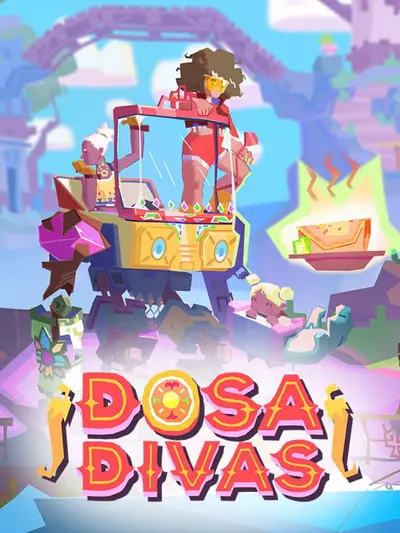
Dosa Divas
68Quick answer
Quick answer
Dosa Divas is een warme, charmante RPG die vooral scoort op sfeer, personages en het plezier van koken en ontdekken. De mix van turn-based gevechten, lichte platformactie en community-building werkt, maar blijft vaak net te eenvoudig om echt lang te blijven boeien. Toch is dit een game met een groot hart en genoeg smaak om bij te blijven.
Ik geef Dosa Divas een 68 omdat de charme, sfeer en kookfocus sterk zijn, maar de systemen en gevechten te licht blijven voor een hogere score.
A world built around warmth
Dosa Divas knows exactly what it wants to be from the opening moments: colorful, comforting, and full of personality. This is a game that treats food, friendship, and community as the emotional center of the experience, and that choice gives it a very distinct identity. The result is immediately inviting. It feels less like a grim quest through danger and more like a cheerful journey through a world that wants you to slow down, explore, and enjoy the ride.
That tone does a lot of heavy lifting. The story about family, reconciliation, and earning trust with local communities gives the game a genuine heart, even when the stakes stay relatively light. It is not trying to overwhelm you with drama. Instead, it builds a cozy sense of connection that fits the food theme beautifully. The world feels alive because it is full of small human moments, and the game understands that charm can be just as important as complexity.
Presentation plays a huge role in making that work. The art direction is bright and welcoming, the characters have a lot of personality, and the overall atmosphere feels handcrafted with care. Nothing about the game looks or sounds cynical. Even when it is being playful, it still feels sincere. That sincerity matters, because it gives the whole adventure a sense of purpose beyond simply moving from one objective to the next. You are not just passing through this world; you are being invited into it.
Combat, cooking, and exploration
The gameplay loop mixes turn-based combat, light platforming, mech upgrades, and cooking minigames. On paper, that sounds busy, but in practice it comes together in a way that feels approachable and easy to understand. The combat is serviceable and occasionally enjoyable, especially when it ties into the broader theme of preparation and resourcefulness. The upgradeable mech adds a bit of flavor to traversal and encounters, giving the adventure a playful mechanical hook.
The cooking systems are where the game shines most clearly. Discovering recipes and turning them into useful rewards gives the whole adventure a satisfying sense of purpose. The minigames are simple, but they are designed with enough rhythm and personality to keep them pleasant rather than tedious. There is also a nice sense of social progression in how you build reputation with different communities. That layer gives your actions meaning beyond immediate rewards, reinforcing the idea that this is a journey about belonging as much as survival.
Still, the mechanics rarely evolve into something truly deep. The combat lacks the kind of tactical richness that would make it memorable over a longer runtime, and the platforming is mostly there to break up the pace rather than challenge you in a meaningful way. The systems are competent, but they do not always grow beyond their initial appeal. As a result, the game often feels like a very tasty appetizer rather than a full multi-course meal.
That is not a fatal flaw, but it does shape the experience in important ways. If you enjoy games that introduce a handful of mechanics and then let atmosphere, pacing, and theme do the rest, Dosa Divas will probably land well. If you want a combat system that keeps unfolding in new directions or a progression model that constantly opens up fresh strategies, this one may feel a little too modest. The ingredients are good; the recipe just never becomes especially elaborate.
Progression and pacing
One of the game’s biggest strengths is also one of its limitations: it is compact. Dosa Divas moves at a brisk pace, and that helps keep the experience focused and digestible. There is very little dead air, and the game is good at introducing an idea, letting you enjoy it, and then moving on before it overstays its welcome. That keeps the momentum alive, especially for a story-driven indie RPG with a strong aesthetic identity.
But the short runtime also means some ideas do not get enough room to breathe. A few systems feel like they are just beginning to open up when the game is already heading toward its conclusion. The final stretch can also feel a little padded, which is frustrating because the rest of the experience is so efficient. The result is a game that leaves you wanting a bit more depth, more variety, and maybe a little more mechanical confidence in the second half.
That sense of incompleteness is probably the main reason Dosa Divas does not quite reach the level of a standout RPG. It has a strong identity, and it uses its runtime well for the most part, but it never fully escapes the feeling that it is sketching out a promising idea rather than fully exhausting it. The pacing keeps things moving, yet the brevity also prevents the game from building the kind of momentum that would make its best ideas truly resonate.
Presentation and personality carry the day
Where Dosa Divas really succeeds is in the way it presents itself. The art direction is vibrant, the tone is consistently upbeat, and the whole package feels handcrafted with affection. There is a sincerity here that makes the game easy to root for. Even when a mechanic is simple or a sequence is over before it has fully matured, the game’s personality keeps it engaging.
That personality is the reason the game lands above average. It is not because every system is polished to perfection, or because the combat is endlessly deep. It is because the game understands how to create a mood and stay true to it. The food theme is not just decoration; it shapes the story, the structure, and the emotional rhythm of the experience. That cohesion matters a lot, and it is what makes the game feel memorable even when its mechanics are relatively restrained.
The emotional core helps too. The family angle gives the adventure a human center, while the community-building elements make your progress feel socially meaningful. Those touches do not transform the game into something sprawling or complex, but they do make it feel considered. You can sense the care behind the design, and that care goes a long way when the systems themselves are intentionally light.
Dosa Divas is ultimately a charming, heartfelt RPG that succeeds more through flavor than force. It is easy to like, occasionally delightful, and a little too modest to become truly great. But as a compact adventure with a big heart, it leaves a pleasant aftertaste. If you are in the mood for something warm, welcoming, and just a little offbeat, this is a journey worth taking.
Verdict
Dosa Divas is een sympathieke, smaakvolle RPG die meer charme dan diepgang biedt, maar precies genoeg karakter heeft om aan te raden.
At a glance
Pros
- Warme, charmante presentatie met sterke sfeer
- Kookmechanieken en recepten zoeken voelen leuk en passend
- Het verhaal rond familie en gemeenschap geeft de game hart
- De compacte opzet houdt het tempo meestal prettig hoog
Cons
- Gevechten missen vaak echte diepgang
- Sommige systemen blijven te eenvoudig om lang te boeien
- De korte speelduur laat ideeën soms te snel voorbijgaan
- De finale voelt iets te veel als opvulling
Screenshots
More reviews
Other recent game reviews on GAME-scanner.
There are no other reviews to show yet.