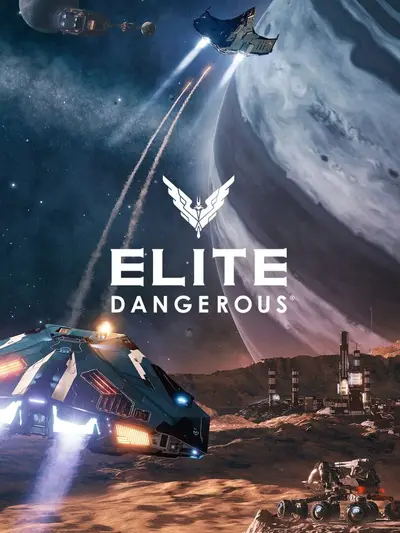
Elite: Dangerous
67Quick answer
Quick answer
Elite: Dangerous is een indrukwekkende ruimte-sandbox die vooral schittert wanneer je zelf je doel bepaalt. De schaal, de vluchtbeleving en de vrijheid zijn uitzonderlijk, maar de game vraagt ook veel geduld en verdraagt weinig als je op duidelijke sturing of snelle beloning hoopt. Voor liefhebbers van harde simulatie en zelfontdekking is dit een fascinerende reis; voor anderen voelt het al snel stroef en afstandelijk.
Ik geef Elite: Dangerous een 67 omdat de vrijheid, schaal en vluchtbeleving uitzonderlijk zijn, maar de stroefheid, herhaling en afstandelijke uitleg de game te vaak afremmen.
A galaxy you do not just visit, but inhabit
Elite: Dangerous is one of those rare games that does not try to win you over with a tightly scripted story or a constant stream of dramatic set pieces. Instead, it offers something harder to define and, in the right hands, far more powerful: a sense of place. From the moment you settle into the cockpit, it becomes clear that this is not a conventional space adventure. It is a life in the stars, built around a ship, a route, a reputation, and a galaxy so vast that it can seem indifferent to your presence.
That scale is the game’s first and most obvious achievement, but it is more than a technical talking point. The Milky Way here is not just a backdrop; it is the structure around which everything else is built. A jump to another system, a long haul to a trading hub, or a detour into unexplored space can feel almost ceremonial because the game gives distance real meaning. You are not simply moving from objective to objective. You are traveling through a living framework that makes even small accomplishments feel earned.
The cockpit as a home base
The heart of Elite: Dangerous is its flight model, and it remains one of the game’s greatest strengths. Piloting a ship feels deliberate and physical in a way that many space games never quite manage. Mass, momentum, speed, and positioning all matter, and that gives every maneuver a sense of consequence. Docking at a station, lining up a hyperspace jump, or escaping a bad fight can all become tense, memorable moments because the game respects the difficulty of controlling a machine in three-dimensional space.
The cockpit view is a huge part of why this works so well. You are not watching a ship from the outside as much as living inside a machine full of instruments, alerts, and systems that demand attention. That makes the game less immediately welcoming, but much more immersive. The interface can be busy and sometimes awkward, yet it reinforces the feeling that you are a pilot managing a complex craft rather than a character in a simplified action game.
Combat benefits from the same philosophy. This is not a game where success comes from twitch reflexes alone. Positioning, energy management, and reading your opponent all matter. That makes victories feel earned and defeats feel instructive, at least when the systems are working in your favor. The best fights are tense because they are about control, not just firepower.
Freedom as the main attraction
Elite: Dangerous is built around the idea that you define your own success. You can trade, mine, explore, hunt pirates, run missions, or simply try to survive in a galaxy that rarely hands out easy wins. That open structure is not a side feature; it is the entire point. Rather than pushing you down a single path, the game offers a set of viable careers and lets you decide which one, if any, becomes your story.
That freedom gives the sandbox a surprisingly personal shape. One player may spend dozens of hours learning trade routes and building a profitable cargo operation. Another may disappear into the black, mapping unexplored systems and chasing the thrill of discovery. Someone else may focus on bounty hunting or combat contracts, treating the galaxy as a place to test skill and ship build alike. The game does not lock you into a class or a narrative role. Your identity emerges from your choices.
The option to play solo, in a private group, or in open online space adds another layer to that freedom. It means the game can be a solitary journey, a social experience with friends, or a more unpredictable shared universe depending on your preference. That flexibility is one of the reasons Elite: Dangerous remains appealing to such different kinds of players.
A brilliant sandbox with rough edges
For all its ambition, Elite: Dangerous is not a gentle introduction to space simulation. Its onboarding is poor, and that is one of the game’s most persistent problems. Important systems are explained only partially, menus can be unintuitive, and the game often assumes you are willing to learn by trial, error, and outside research. If you enjoy figuring things out for yourself, that can be part of the appeal. If you want clear direction, it can feel like the game is withholding basic information.
That learning curve is made steeper by the game’s pacing. Progress is often slow, and many activities rely on repetition to build momentum. The result is a structure that can feel rewarding over the long term but tiring in shorter sessions. Some players will appreciate the sense of gradual accumulation, where every upgrade and every new ship feels like a hard-won step forward. Others will simply feel the grind.
This is where Elite: Dangerous becomes a very specific kind of recommendation. It is easy to admire from a distance because the systems are ambitious and the galaxy is enormous. It is harder to love if you need constant feedback, clear goals, or a steady stream of new content. The game asks for patience, and it does not always repay that patience quickly.
Repetition, grind, and the right mindset
The repetition in Elite: Dangerous is not accidental; it is part of the design. The game wants you to build routines, learn routes, and slowly improve your ship and your understanding of the galaxy. For the right player, that creates a satisfying sense of career progression. You are not racing toward a final boss or a dramatic ending. You are building a life.
But that same structure can also make the game feel like work. Not every mission is memorable, not every flight leads to discovery, and not every upgrade changes the way you play in a meaningful way. The distance between interesting moments can be large, and if you are not in the mood for a slow-burn simulation, the experience can start to feel empty. Elite: Dangerous is at its best when you accept that the journey itself is the point. If you need more immediate payoff, its rhythms can become exhausting.
Sound and atmosphere do a lot of the heavy lifting
One area where Elite: Dangerous consistently excels is atmosphere. The sound design is especially strong, giving engines, stations, weapons, and the silence of space a weight that helps sell the fantasy. Audio is not just decorative here; it is part of the navigation, the tension, and the sense that you are operating a real machine in a real environment. Few games use sound as effectively to make the galaxy feel inhabited and mechanical at the same time.
The visuals follow a similar philosophy. Rather than chasing constant spectacle, the game leans into a sober, believable sci-fi aesthetic. Planets, stars, and stations are rendered with enough realism to make the galaxy feel tangible rather than decorative. That creates moments of genuine awe, especially when a distant station slowly resolves out of the dark or a new system opens up after a long journey.
There is a trade-off, though. The game is often beautiful, but rarely warm. It creates wonder more than drama, and it leaves much of the emotional meaning up to the player. For some, that restraint is exactly what makes it special. For others, it will make the universe feel cold in the wrong way.
Verdict
Elite: Dangerous is a remarkable space simulation with a genuinely special sense of scale, freedom, and cockpit-driven immersion. Its flight model is excellent, its atmosphere is memorable, and the sheer size of its galaxy gives it a presence that few games can match. When its systems click, it can be deeply absorbing.
At the same time, it is held back by poor onboarding, opaque systems, and a progression loop that can become repetitive and slow. That makes it a difficult game to recommend universally. For players who enjoy learning complex systems, setting their own goals, and living with a slower pace, it can be extraordinary. For everyone else, it is likely to feel more impressive than inviting.
In the end, Elite: Dangerous is not a game that wants to be liked by everyone. It wants to be inhabited by the right kind of player. If you are that player, the galaxy is waiting.
Verdict
Een indrukwekkende maar veeleisende ruimte-sandbox die vooral schittert voor spelers met geduld en een liefde voor simulatie.
At a glance
Pros
- Enormous scale that makes the galaxy feel real
- Sterke cockpit-vluchtbeleving en gevechtsgevoel
- Veel vrijheid om je eigen rol en doelen te kiezen
Cons
- Slechte onboarding en weinig duidelijke uitleg
- Herhaling en trage progressie kunnen vermoeien
Screenshots
More reviews
Other recent game reviews on GAME-scanner.
There are no other reviews to show yet.