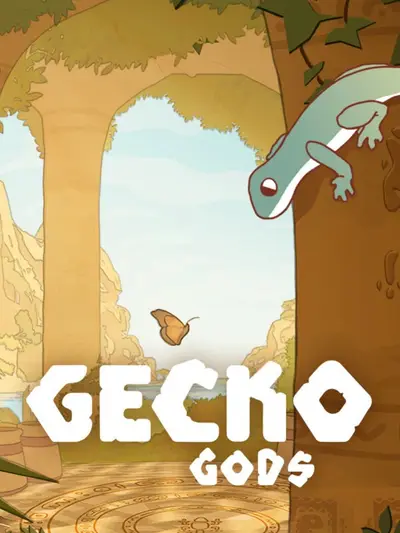
Gecko Gods
76Quick answer
Quick answer
Gecko Gods is een ontspannen avontuur waarin je als kleine hagedis een vergeten eiland verkent, puzzels oplost en zonder gedoe langs muren en kliffen klautert. De charme zit vooral in de unieke beweging, de rustige sfeer en de manier waarop verkenning centraal staat. Tegelijk blijft het een vrij compacte ervaring met af en toe technische en ontwerpmatige haperingen.
De score weerspiegelt een sterke kern met originele traversal en sfeer, maar ook genoeg oneffenheden om net onder de topklasse te blijven.
A tiny pilgrim in a forgotten place
Gecko Gods wins you over quickly with its premise alone: you are not a chosen warrior or a grand explorer, but a small lizard crossing the remains of an ancient island civilization. That perspective does a lot of heavy lifting. Ruins feel larger, cliffs feel steeper, and every ledge becomes a tiny achievement. The world is built around this scale, and the result is a game that feels intimate rather than epic in the usual sense.
That intimacy is one of its biggest strengths. The island has a quiet, almost reverent mood, and the game is happy to let that mood breathe. Instead of pushing constant spectacle, it encourages slow observation and gentle curiosity. Eating bugs, clambering over walls, and slipping through narrow routes gives the whole experience a tactile, playful quality. It is a game that wants you to notice the place you are in, not just race through it.
Traversal that changes how exploration works
The standout mechanic is the gecko movement itself. Being able to walk on walls and climb surfaces with such freedom changes the entire shape of exploration. What would normally be a simple obstacle becomes part of the puzzle. Verticality matters constantly, and the game makes good use of that by building routes that feel designed around unusual movement rather than bolted onto standard platforming.
At its best, this creates a very satisfying flow. You look at a structure, read the environment, and then realize the route is not about raw reflexes but about understanding how your body works in this world. That makes progress feel earned without becoming stressful. It is a relaxed kind of problem-solving, and the game is confident enough to let that be the main attraction.
Puzzles, pacing, and progression
The puzzles generally land in a sweet spot. They are thoughtful enough to make you pause, but not so demanding that they derail the mood. That balance matters a lot here, because Gecko Gods is clearly aiming for a calm adventure rather than a punishing challenge. When the design is working, it feels like a pleasant conversation between you and the environment: small clues, subtle routes, and a steady sense of discovery.
Progression is a little less consistent. The game’s openness is part of its charm, but it can also make the next step feel fuzzy at times. Some players will enjoy that loose, exploratory structure; others may find themselves wanting a firmer hand. There are also moments where the platforming and puzzle logic do not feel quite as polished as the core concept deserves. None of this breaks the experience, but it does keep the game from fully locking into a flawless rhythm.
A compact island that feels carefully built
The island itself is not huge, and that works in the game’s favor. Rather than stretching itself thin, Gecko Gods focuses on making each area feel deliberate. The ruins, natural surfaces, and hidden paths are arranged with enough care that the world feels handcrafted. You can sense where the designers want your eye to go, but the game rarely feels pushy about it.
That compactness also helps the atmosphere. Because the island is relatively small, its details become more memorable. A broken archway, a mossy wall, a sunlit ledge, or a tucked-away chamber all stand out more when the game is not trying to overwhelm you with scale. The result is a place that feels ancient and lived-in, even though it is clearly designed to support a focused adventure.
There is also a nice sense of environmental storytelling in the way the world is presented. You are not handed long explanations about the civilization that once lived here. Instead, the architecture and layout do the talking. That restraint suits the game well, because it keeps the focus on discovery rather than exposition.
Presentation and atmosphere
Visually, the game has a lot going for it. The art direction is warm and inviting, with enough detail to make the island feel ancient without drowning it in clutter. The presentation supports the tone well: this is a world that feels weathered, mysterious, and just a little magical. The smaller scale also helps the game’s personality shine through, because every area feels like a handcrafted space rather than a generic open map.
The atmosphere is especially effective because it never tries too hard. Gecko Gods understands that charm can come from restraint. The quiet pacing, the tactile movement, and the simple pleasure of finding your way across a strange place all work together. Even the act of eating bugs or hugging a wall becomes part of the game’s identity. It is a small detail, but one that reinforces the feeling that you are inhabiting a creature with its own logic and strengths.
Technical rough edges and design friction
Still, the polish is uneven. A few technical hiccups and some rougher edges in execution prevent the game from feeling as smooth as its best ideas suggest. Those issues are not constant, but they are noticeable enough to matter. When a game is built around calm exploration and friction-free movement, even modest stumbles can stand out more than they otherwise would.
That is especially true here because the game’s strengths are so dependent on flow. If the movement is the hook, then any moment where the movement, camera, or progression feels unclear becomes more disruptive than it might in a more chaotic action game. The developers clearly have the right instincts, but the experience still feels like it could use another layer of refinement before it fully matches the quality of its concept.
Final thoughts
Gecko Gods is a charming, distinctive indie adventure that succeeds most when it trusts its own unusual movement and quiet sense of discovery. It is not trying to be a giant, all-consuming platformer; it is trying to be a focused, atmospheric journey through a strange little world. On that level, it works very well.
The rough spots keep it from reaching the highest tier, but they do not erase what makes it memorable. If you want a short, thoughtful exploration game with personality and a genuinely fresh traversal hook, this is an easy one to appreciate.
Why it stands out
What lingers after playing Gecko Gods is not a checklist of systems, but a feeling. It is the feeling of moving like a tiny creature through a place built for giants, of turning walls into pathways, and of solving problems by paying attention rather than by forcing your way through them. That is a rare enough combination that the game deserves credit even where it stumbles.
It may not be perfectly polished, but it is memorable, and in a crowded genre that matters. Gecko Gods is the kind of game that can easily become a favorite for players who value mood, movement, and compact design over sheer scale. Its best ideas are strong enough to carry it, and its rough edges are mostly the sort you can forgive when a game has this much personality.
Verdict
Een charmante, eigenzinnige puzzel-platformer die vooral overtuigt door beweging en sfeer.
At a glance
Pros
- Unieke muurklim en traversal geven verkenning een frisse draai
- Sterke, rustige sfeer met veel charme
- Puzzels zijn meestal slim maar toegankelijk
- De eilandwereld voelt klein maar zorgvuldig opgebouwd
Cons
- De progressie kan soms wat vaag of los aanvoelen
- Technische en ontwerpmatige rough edges halen de glans eraf
Screenshots
More reviews
Other recent game reviews on GAME-scanner.
There are no other reviews to show yet.