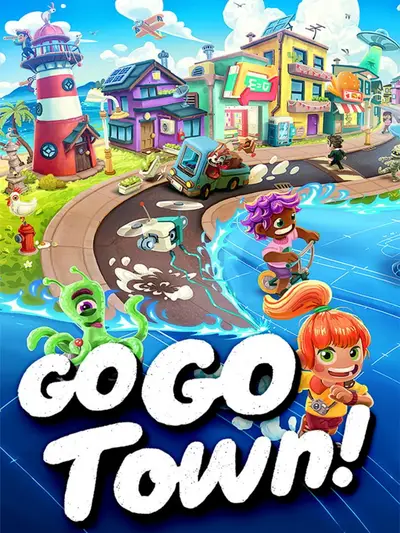
Go-Go Town!
76Quick answer
Quick answer
Go-Go Town! is een charmante, toegankelijke stadsbouwer die vooral uitblinkt in zijn relaxte tempo en verslavende groeiloop. Ik vond het heerlijk om mijn nederzetting stap voor stap uit te bouwen, al blijven de systemen bewust licht en wordt de lat voor uitdaging nooit heel hoog gelegd. Vooral in co-op komt de chaos echt tot leven, maar ook solo is dit een prettig verslavende managementgame.
76/100 – sterk in sfeer, flow en toegankelijkheid, maar net te licht en te veilig voor een hogere score.
A cozy mayor sim that gets to the fun quickly
In my time with Go-Go Town!, what stood out to me immediately was how welcoming it is. The game does not waste much time burying me in menus or demanding that I master a web of systems before I can enjoy myself. It gets me building fast, then keeps feeding me a steady stream of visible progress. That immediate sense of ownership is a huge part of why I kept coming back for “just one more task.”
I played on Xbox Series X|S, and the experience felt nicely direct there. The controls and interface stayed out of my way, which matters a lot in a town builder where I am constantly placing, adjusting, and checking logistics. I never felt like I was fighting the game to make basic decisions. Instead, I was usually moving from one small improvement to the next, and that rhythm suited me very well.
What I also appreciated is how naturally the game sells the fantasy of being a hands-on mayor. I was not just dropping buildings into empty space; I was shaping a little town that gradually started to feel alive through my choices. I found myself caring about tiny upgrades more than I expected, because each one had a clear effect on how the place looked and functioned. That personal connection is one of the game’s biggest strengths.
The core loop: build, gather, improve, repeat
The heart of Go-Go Town! is simple, but it works. I gathered resources, expanded infrastructure, managed basic needs, and slowly turned a tiny settlement into something more organized and ambitious. What I liked most is that the game rarely makes me stop and study systems for too long. It nudges me forward, lets me experiment, and then rewards me with a new layer of efficiency or a more polished-looking town.
That accessibility is a big reason the game feels so easy to settle into. I was usually relaxing rather than sweating over a crisis, and I mean that as a compliment. The challenge is gentle, which fits the cozy tone, but it also means the systems never become especially demanding. I found that balance pleasant for a long stretch, though it does mean the game is not chasing the kind of complexity that heavier strategy fans may want.
I could also feel that some parts of the experience are better suited to co-op. Playing solo still works well, and I enjoyed having total control over the town’s direction, but I occasionally noticed the extra running around that solo play creates. It never became a deal-breaker, yet I could easily see why sharing the workload would make the whole thing feel smoother and more chaotic in the best way.
Logistics, tidying chaos, and the joy of visible progress
What I found most satisfying was the way the game turns small logistical improvements into meaningful progress. A better route here, a more efficient setup there, and suddenly the whole town feels less messy and more capable. I love games that make organization feel rewarding, and Go-Go Town! absolutely understands that appeal. Even when I was doing mundane work, I still felt like I was moving the town forward.
That constant sense of forward motion is what kept me hooked. I would fix one bottleneck, then immediately notice another area that could be improved, and the loop kept feeding itself. I enjoyed how the game made small decisions feel worthwhile without turning every action into a stressful optimization puzzle. It is a very comfortable kind of management, but not a passive one. I was always doing something that mattered, even if the task itself was simple.
At the same time, I have to note that the depth stays relatively light. I did not run into the kind of layered simulation systems that keep changing how you play hour after hour. Instead, the game leans on charm, pace, and the satisfaction of expansion. That is enough to carry it a long way, but I did feel repetition creeping in during longer stretches. The loop remains enjoyable, just not endlessly surprising.
Presentation and tone do a lot of heavy lifting
The presentation helps a lot. I found the art style bright, readable, and easy to settle into, which matters in a game where I spent so much time scanning my town and planning the next move. The world has a playful personality, and the writing adds to that without overdoing it. Even the audio approach has a quirky charm that fits the game’s laid-back identity.
There is a lighthearted energy running through everything, and that kept me engaged even when I was doing repetitive tasks. I never felt like the game was trying to impress me with spectacle. Instead, it wins through consistency: a pleasant look, a friendly tone, and a constant sense that the next small upgrade will be worth it. I found that approach surprisingly effective, because it makes the whole experience feel warm rather than mechanical.
I also appreciated that the game knows how to be funny without turning into a joke machine. The humor is part of the texture rather than the whole point, and that keeps the tone from becoming tiring. It gives the town a little extra personality, which matters more than it might sound in a genre where presentation can easily become purely functional.
Solo works well, but co-op sounds like the real chaos button
I played mostly solo, and Go-Go Town! absolutely holds up that way. I had full control over the town’s direction and could work at my own pace, which made the experience feel calm and manageable. I never felt like I was missing the game’s core appeal just because I was alone. If anything, solo play made the planning side feel more deliberate, because every decision was mine.
That said, I could feel that the game is probably at its funniest when shared. Some of the running around and task juggling naturally lends itself to co-op, and I can imagine the whole thing becoming even more lively with a couple of friends helping out. Solo is solid, but I noticed the extra travel and busywork more clearly than I probably would in a group. It is not a flaw so much as a reminder that the game’s design clearly welcomes company.
What I appreciate is that solo never feels like a compromise. I did not get the sense that I was playing the “wrong” version of the game. Instead, I got a relaxed, self-directed town builder that still delivered plenty of small wins. That makes it easy to recommend to anyone who prefers to build alone, even if co-op looks like the more chaotic and potentially more entertaining option.
Where it plays it safe
My main criticism is that Go-Go Town! sometimes plays it too safe. I wanted a bit more friction, more surprise, or more late-game systems that would force me to rethink my town from the ground up. Instead, the game mostly stays in its comfort zone, which makes it approachable but also keeps it from becoming truly memorable in a genre full of deeper management sandboxes.
I also noticed that the late game can feel a little grindy. The satisfaction is still there, but the pace does not always evolve enough to keep every task fresh. I still enjoyed the loop, yet I could feel the repetition more clearly once the novelty of expansion had worn off. For me, that did not ruin the experience, but it did stop the game from reaching the next level of depth I was hoping for.
Even so, I came away with a very positive impression because the core loop is so pleasant and the game knows exactly what kind of experience it wants to be. It is not trying to compete with the heaviest city builders on complexity. It is aiming for charm, clarity, and a satisfying sense of growth, and on those terms it succeeds very well.
Final thoughts
For me, Go-Go Town! is a charming, easy-to-like town builder that delivers more fun than complexity. I enjoyed my hours with it, and I can see it becoming a comfortable go-to game for anyone who wants a cheerful management sim without heavy pressure. I liked how quickly it got me invested, how consistently it rewarded small improvements, and how well it maintained its cozy tone.
At the same time, I cannot ignore that the depth is intentionally limited and that the late game can start to feel repetitive. Those are real limitations, but they are also part of the game’s identity. If you want a relaxed mayor sim with a strong growth loop, a friendly presentation, and enough charm to carry the quieter moments, this is an easy recommendation from me.
Verdict
Een warme aanrader voor wie vooral ontspanning, groei en gezellig management zoekt.
Frequently asked questions
Is Go-Go Town! de moeite waard?
Ja, vooral als je houdt van toegankelijke city builders met een relaxte sfeer. De game blinkt uit in het opbouwen van een stadje dat stap voor stap groeit, maar blijft bewust licht in complexiteit.
Hoe lang duurt Go-Go Town!?
Een eerste stevige speelronde kan gemakkelijk tientallen uren vullen, zeker als je graag optimaliseert en uitbreidt. De exacte duur hangt af van hoeveel je experimenteert en of je solo of in co-op speelt.
Heeft Go-Go Town! co-op?
Ja, de game ondersteunt co-op en dat past goed bij de chaotische, logistieke opzet. Samen spelen maakt het verdelen van taken makkelijker en kan de ervaring vlotter en leuker maken.
Is de game moeilijk?
Nee, de game is eerder toegankelijk dan streng. De uitdaging zit vooral in efficiënt plannen en het netjes laten groeien van je stad, niet in harde straffen of complexe managementdruk.
Op welk platform speelt Go-Go Town! het best?
De review is gebaseerd op Xbox Series X|S. De game is ook aangekondigd voor meerdere andere platforms, maar de ervaring kan per systeem verschillen.
At a glance
Pros
- Charmante, toegankelijke stadsbouwer met een sterke groeiloop
- Leuk en overzichtelijk bouwen zonder overdreven complexiteit
- Co-op en solo werken allebei, met veel kleine beloningen onderweg
Cons
- De diepgang blijft bewust beperkt
- De latere uren kunnen wat herhalend en grindy aanvoelen
Screenshots
More reviews
Other recent game reviews on GAME-scanner.
There are no other reviews to show yet.