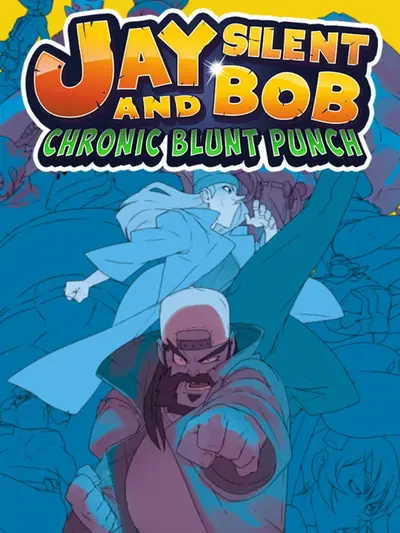
Jay and Silent Bob: Chronic Blunt Punch
58Quick answer
Quick answer
Jay and Silent Bob: Chronic Blunt Punch is een beat-'em-up die vooral scoort op sfeer, humor en een opvallende presentatie. De actie is soms leuk genoeg om door te spelen, maar te vaak zitten haperende besturing, repetitie en technische ruwe randjes de pret in de weg. Voor fans van Kevin Smith is dit een charmante, maar verre van vlekkeloze trip.
De score weerspiegelt een game met duidelijke stijl en plezierige momenten, maar ook genoeg technische en mechanische problemen om het totaalbeeld in de middenmoot te houden.
Jay and Silent Bob: Chronic Blunt Punch makes its pitch immediately: this is a loud, rude, self-aware beat ’em up that lives and dies on personality. Fortunately, it has plenty of that. The game understands the tone of Kevin Smith’s universe and leans into it with confidence, delivering a barrage of stoner jokes, pop-culture references, and shameless nonsense that should feel right at home for fans. It doesn’t try to be subtle, and that’s exactly why it works as well as it does in its best moments.
What stands out first is how committed the game is to its identity. Too many licensed or franchise-adjacent brawlers settle for a generic look and a few familiar names, but Chronic Blunt Punch feels like it was built around the attitude of its source material from the ground up. The result is a game with a clear voice. Even when the writing gets a little too broad or a joke lands with more of a shrug than a laugh, the overall tone remains consistent enough to carry the experience. This is not a game trying to appeal to everyone. It knows exactly who it is for.
Presentation and atmosphere
The visual presentation is one of the game’s biggest strengths. The 2.5D side-scrolling structure gives the action a nice sense of depth, while the colorful art direction makes each stage feel lively and distinct. Characters pop off the screen, backgrounds are packed with detail, and the effects add energy without making the action hard to read. That matters in a brawler, where clarity is just as important as style. Chronic Blunt Punch usually manages both, which helps it rise above the average indie punch-up.
The hand-drawn look gives the whole thing a strong personality, and that personality is reinforced by the humor. The game doesn’t just reference the View Askewniverse; it feels like it belongs to it. There’s a looseness to the presentation that suits the material, but it still looks polished enough to avoid feeling sloppy. The result is a world that is immediately recognizable and easy to enjoy, even if you’re only casually familiar with the characters. It’s colorful, crude, and visually memorable in a way that many brawlers simply aren’t.
Combat and co-op
At its core, Chronic Blunt Punch is built on familiar beat ’em up fundamentals: move through stages, clear out groups of enemies, chain attacks together, and use special moves when the screen gets crowded. When the combat clicks, it can be genuinely fun. Hits have a decent sense of impact, the pacing is brisk, and the game creates a satisfying rhythm during larger fights. In co-op, that rhythm becomes even more enjoyable because the tag-team setup adds a layer of chaos and coordination that suits the material well.
That said, the combat never fully shakes off a rough edge. Controls can feel clunky, inputs sometimes don’t register with the precision you’d expect, and hit detection can be inconsistent enough to make some encounters feel unfair or awkward. Those issues don’t completely break the game, but they do keep it from feeling as sharp as it should. In a genre that depends on responsiveness, even small amounts of friction can have a big impact on enjoyment. Here, that friction is noticeable often enough to matter.
Enemy variety is another weak point. The game introduces enough opposition to keep the action moving, but not enough to keep it fresh for long. Once you’ve seen a few enemy types and learned how the game wants you to handle them, the fights start to blur together. That repetition is less of a problem in short sessions, but over the full runtime it becomes hard to ignore. The combat is serviceable and occasionally fun, yet it rarely evolves in ways that make it truly memorable.
Structure and pacing
The campaign is short, which is both a blessing and a limitation. On one hand, the game avoids overstaying its welcome. On the other, it doesn’t have much room to develop new ideas or build momentum through meaningful mechanical changes. The structure is straightforward to the point of predictability: move from one combat space to the next, fight through waves of enemies, and keep going until the credits roll. That works fine for a compact arcade-style experience, but it also means the game leans heavily on tone and presentation to maintain interest.
Level design is similarly conventional. Stages serve as backdrops for fights more than as spaces that change how you play. There are few surprises, and the game rarely introduces objectives or environmental twists that alter the flow in a significant way. As a result, the pacing is steady but not especially exciting. It’s easy to get through, but not always easy to stay fully engaged. The short runtime helps, yet it also highlights how little the formula changes from start to finish.
Technical roughness
The technical side is where the game loses the most ground. There are bugs, uneven responsiveness, and a general sense that the polish is not quite where it should be. None of these issues are catastrophic on their own, but together they make the experience feel less refined than the presentation suggests. When a game relies so heavily on style, the underlying systems need to be especially solid. Here, they are merely adequate, and that’s a problem.
That roughness is especially frustrating because the game clearly has ideas worth enjoying. The humor is on point more often than not, the art direction is distinctive, and the co-op setup gives the brawler formula a welcome burst of energy. But every time the controls hesitate or a hit fails to connect the way it should, the illusion weakens. The game wants to be a breezy, funny, high-energy romp; instead, it often feels like a promising idea held back by execution.
Who should play it?
This is a game for a specific audience. If you already enjoy Jay and Silent Bob, Kevin Smith’s style of humor, or the broader universe these characters inhabit, there is a good chance you’ll find plenty to like here. The references, the tone, and the visual personality all come together to create something that feels made for fans. In co-op, especially, the game can be a fun short-term diversion with just enough charm to justify the time.
If, however, you’re mainly looking for a beat ’em up with tight controls, deep combat, and strong replay value, Chronic Blunt Punch is less convincing. It has enough personality to make a good first impression, but not enough mechanical depth or technical polish to sustain that impression for long. The result is a game that is easy to appreciate and harder to wholeheartedly recommend.
Jay and Silent Bob: Chronic Blunt Punch is ultimately a mixed bag, but an interesting one. It’s funny, colorful, and unmistakably itself, yet also repetitive, rough around the edges, and mechanically less precise than it needs to be. Fans of the source material will likely forgive more of its flaws than most, and in that sense the game succeeds where it matters most. For everyone else, it remains a charming but flawed brawler that looks better than it plays.
Verdict
Charmant en opvallend, maar te oneffen om echt hoog te scoren.
At a glance
Pros
- Sterke, herkenbare Kevin Smith-sfeer en humor
- Kleurrijke 2.5D-presentatie met veel karakter
- Leuker in co-op dankzij de tag-team-opzet
Cons
- Besturing en hitdetectie voelen soms stroef of onnauwkeurig
- Leveldesign en vijandvariatie worden snel repetitief
Screenshots
More reviews
Other recent game reviews on GAME-scanner.
There are no other reviews to show yet.