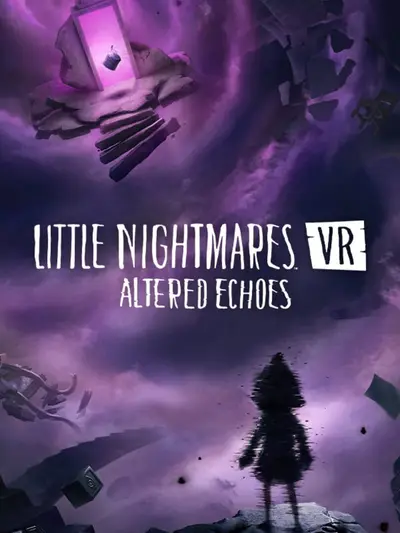
Little Nightmares VR: Altered Echoes
73Quick answer
Quick answer
Little Nightmares VR: Altered Echoes zet zijn beklemmende wereld overtuigend om naar virtual reality en maakt van kijken opeens écht aanwezig zijn. De sfeer, de groteske vijanden en de sterke set pieces dragen het avontuur ver, al blijft de campagne aan de korte kant en voelt de besturing soms wat stroef. Het resultaat is een meeslepende, soms indrukwekkende horrorpuzzel die vooral fans van de reeks veel te bieden heeft.
Onze score van 73 weerspiegelt een zeer geslaagde, sfeervolle ervaring die net niet genoeg diepgang of soepelheid heeft om echt uit te groeien tot een topklassieker.
Stepping inside the nightmare
Little Nightmares VR: Altered Echoes understands the series’ core appeal almost immediately: the thrill of being tiny, vulnerable, and trapped in a world that feels far too large and far too hostile. In VR, that idea gains a new kind of force. You are no longer watching the dread from a distance; you are physically inside it, turning your head, leaning back, and trying to judge danger by sound, shape, and movement. That shift works remarkably well. The game builds tension not just through darkness and distorted silhouettes, but through the sheer presence of rooms, objects, and enemies that feel much more intimate and threatening than they ever could on a flat screen.
That is the game’s biggest strength: immersion. The world is disgusting, but also strangely beautiful in its own twisted way. Every area seems to tell a story through grime, broken furniture, damp surfaces, and monstrous forms lurking just beyond sight. The move to VR does not feel like a gimmick; it feels like a natural extension of a series that has always relied on perspective and unease. On a normal display, the franchise can feel like a carefully staged puppet show. Here, it becomes a place you inhabit, and that makes the fear land harder.
The power of presence
What sets Altered Echoes apart from many other horror experiences is how consistently it leans into presence. You feel the scale of a room not just because you see it, but because you move through it. A table is not merely an object in the frame; it is something you have to navigate around, hide beneath, or use as cover. An enemy is not simply a threatening model in the distance; it is a mass that occupies your space, blocks your view, and forces you to physically step back.
That physical relationship with the environment makes the fear more believable. The game does not need to shout all the time to make an impression. Sometimes it is more effective when you are forced to stand still for a few seconds too long, fully aware that something is nearby. The combination of limited sightlines, oppressive spaces, and subtle audio keeps you on edge throughout. Even when nothing is happening, it feels like every sound could be a warning.
That is also where the series’ identity shines in VR: the world is not just a backdrop, but an adversary in its own right. The spaces seem determined to swallow you whole, and that makes every bit of progress feel meaningful. When you finally slip past a danger or unlock a new route, it feels less like completing a puzzle and more like escaping a living nightmare.
Puzzles, stealth, and well-timed panic
In terms of gameplay, Altered Echoes sticks close to the familiar formula: sneaking, observing, solving simple but effective puzzles, and running at exactly the wrong moment from something much bigger and much hungrier. The foundation is not complicated, but it is effective. The puzzles are rarely difficult in a traditional sense, though VR gives them a more physical quality. You are not just thinking through them; you are reaching, positioning, ducking, and interacting with the environment in a way that makes even modest challenges feel more immediate.
The strongest sections are the ones where the game fully commits to its VR identity. Those moments turn the experience into a tense little performance: crouch, grab, wait, release, hide, move. That is where the horror and the interaction click together. The game seems to understand that VR fear does not always need louder monsters or faster chases; sometimes it is enough to make you stand still for a few seconds too long, knowing that something nearby is listening.
Still, the controls are not flawless. In the more frantic sequences, some actions can feel a little clunky, and that matters more here than it would in a regular adventure game. When a horror scene depends on confidence and flow, even a small bit of friction can puncture the illusion. The game usually recovers quickly, but those moments are noticeable enough to keep the experience from feeling completely seamless.
Presentation does the heavy lifting
Visually, this is one of the game’s strongest assets. The art direction is doing a huge amount of work, and it deserves the praise. Everything is warped, but never random; every grotesque detail feels like it belongs to the same nightmare logic. Lighting is used beautifully, and the way spaces gain depth in VR gives the environments a real sense of scale. Some sequences are genuinely striking, especially when the game uses size, distance, and movement to make you briefly forget you are looking at a digital world.
The sound design is equally important. The creak of materials, distant echoes, heavy thuds, and sudden movement in the environment all contribute to a constant sense of unease. Audio is not just atmosphere here; it is part of the gameplay language. You learn to listen as much as you look, which is exactly what a strong VR horror experience should encourage.
The combination of visuals and audio makes the world feel coherent in a way that goes beyond surface-level presentation. The game does not come across as a collection of disconnected horror images, but as a single diseased place where every detail reinforces the same oppressive tone. That is why even the quieter stretches remain tense.
Short, focused, and slightly restrained
The main criticism is that Altered Echoes does not always push its ideas as far as it could. The campaign is short, and some of the mechanics remain fairly straightforward. That would not be a problem if the game kept escalating in surprising ways, but it occasionally settles into repetition instead of building toward something more ambitious. As a result, parts of the adventure feel like a very polished extension of the formula rather than a bold reinvention of it.
Even so, that does not make it slight or forgettable. The game knows exactly what mood it wants to create, and it succeeds more often than not. The pacing is tight enough to keep the experience focused, and the set pieces are often strong enough to justify the limited runtime. There are moments when the game lets you feel something a traditional version of Little Nightmares could only suggest from a distance: the physical closeness of danger, the pressure of a room that seems too small for what is inside it, and the relief of finally getting out.
That is why the short length leaves such a mixed impression. On one hand, it is disappointing that the game does not spend more time developing its ideas. On the other, the compact structure prevents the formula from wearing thin. What remains is a concentrated, atmospheric journey through a world you probably should have admired from afar.
A strong, if imperfect, VR adaptation
Little Nightmares VR: Altered Echoes succeeds because it understands what makes the series emotionally effective and translates that into a medium that suits it surprisingly well. The fear here is not just visual; it is spatial. The tension comes not only from what you see, but from how you move through the environment, how you listen, how you wait, and how you try not to be noticed. That makes the experience unusually effective, even when the mechanics themselves are not always perfectly refined.
The result is a VR adventure that is often impressive, sometimes genuinely oppressive, and almost always atmospheric. The game leans heavily on art direction, sound, and spatial tension, and that is exactly why it works. The short campaign and occasional control friction keep it just below the very top tier, but they do not erase the fact that this is one of the strongest ways to experience the world of Little Nightmares.
Little Nightmares VR: Altered Echoes is an immersive and often impressive VR adaptation, held back only by its brief length and occasional control friction.
Verdict
Een sterke VR-nachtmerrie die vooral indruk maakt met sfeer en aanwezigheid.
At a glance
Pros
- Sterke, beklemmende VR-immersie
- Uitstekende art direction en geluidsontwerp
- Sfeervolle puzzels en spannende set pieces
Cons
- Campagne is aan de korte kant
- Besturing voelt soms wat stroef in drukke momenten
Screenshots
More reviews
Other recent game reviews on GAME-scanner.
There are no other reviews to show yet.