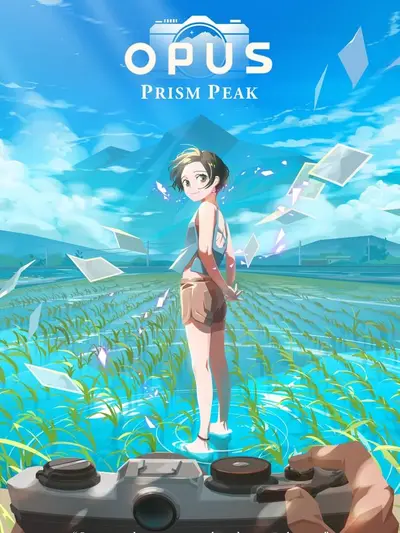
OPUS: Prism Peak
79Quick answer
Quick answer
OPUS: Prism Peak is een sfeervolle narratieve avonturengame die fotografie slim inzet als meer dan een gimmick. De wereld, personages en emotionele toon blijven lang hangen, al remmen het trage tempo en wat logge tussenstukken de vaart af. Wie houdt van rustige, verhaalgedreven games krijgt hier veel moois voor terug.
Sterke sfeer, slimme fotografie en oprechte emotie tillen de game hoog, maar het trage tempo houdt hem net onder de top.
A journey built around attention
OPUS: Prism Peak is the kind of game that asks you to slow down and really look. You play as a photographer lost in an ethereal world, and that premise is more than a backdrop: it shapes the entire experience. The camera is not just a tool for progress, but the main way you interact with the world, uncover its secrets, and make sense of what you are seeing. That gives even simple actions a quiet sense of purpose.
What stands out immediately is how well the game ties mechanics to theme. Taking photos is not a detached side activity; it is the language of the game. You observe, frame, and capture moments in order to understand a place that feels half-memory, half-dream. That makes exploration feel intimate rather than busy, and it helps Prism Peak build an identity that is calm, reflective, and emotionally focused.
Story, tone, and characters
The story leans into melancholy, longing, and the ache of moving forward. Prism Peak is interested in grief and growth, but it approaches those ideas with a gentle hand rather than melodrama. The result is a narrative that often feels personal and human. Its characters are relatable enough to ground the fantasy, yet distinct enough to keep the journey from becoming merely symbolic.
There is a strong sense of atmosphere throughout. The world feels like a place suspended between memory and meaning, and the game uses that ambiguity well. It is not always about solving a mystery in the traditional sense; sometimes it is about sitting with a feeling and letting the scene speak for itself. When the writing and presentation align, the game can be genuinely affecting. It knows how to be tender without becoming sentimental, which is harder to pull off than it sounds.
That emotional restraint is one of the game’s strengths. Rather than forcing every beat into a dramatic crescendo, it lets small interactions carry real weight. A glance, a pause, or a quiet exchange can say as much as a major revelation. Because of that, the characters feel lived-in. They are not just there to explain the world; they help make it feel inhabited.
Photography as the game’s core language
The photography system is the heart of OPUS: Prism Peak, and it is integrated with impressive care. Taking pictures is not a separate minigame bolted onto the adventure. It is how you read the environment, uncover clues, and move the story forward. That gives the game a rare coherence: the act of looking becomes the act of understanding.
This makes exploration more meaningful than it might otherwise be. You are constantly thinking about framing, timing, and what a scene is trying to tell you. Sometimes the payoff is practical, unlocking the next step in the journey. Other times it is emotional, because the image itself captures a mood or memory that lingers. That dual purpose is what makes the mechanic so effective. It keeps the game from feeling passive, even though the overall pace is deliberately calm.
There is also a nice sense of discovery in how the game encourages you to pay attention to details. A path, a silhouette, a shift in light, or a small environmental clue can all matter. Prism Peak rewards curiosity, but it does so in a way that feels thoughtful rather than busy. The camera becomes a way of participating in the world instead of merely documenting it.
Pacing and structure
If Prism Peak has a major weakness, it is the pace. The game is intentionally slow, and that works when the atmosphere is doing the heavy lifting. There is real value in the way it allows scenes to breathe and gives you time to absorb the world. The problem is that some stretches go beyond patient and into sluggish. A few sequences feel padded, and certain transitions have an administrative quality that interrupts the emotional flow.
That does not ruin the experience, but it does make the game feel less consistent than it could have been. The strongest moments are often the ones where the game trusts its own mood and keeps the focus on observation and feeling. The weaker ones are the passages that seem to exist mainly to stretch the runtime or slow the player down. A tighter edit would have made the highs land harder and reduced the sense of repetition.
Still, the structure has a clear intention, and that intention is admirable. Prism Peak is not trying to be a brisk adventure. It wants to create a reflective rhythm, one that mirrors the emotional themes of memory, loss, and acceptance. For players who enjoy that kind of cadence, the pacing may feel appropriate. For others, it may be the main barrier to fully connecting with the game.
Presentation and atmosphere
Visually, OPUS: Prism Peak is striking. The art direction gives the world a painterly quality, with beautiful use of color and lighting that makes every area feel carefully composed. The environments are not just attractive; they are designed to be photographed, which means they naturally guide your eye and reinforce the game’s central mechanic. That harmony between visual design and interaction is one of the game’s biggest achievements.
The audio side is equally important. The soundtrack adds emotional depth without overwhelming the quieter moments, and the voice work helps the characters feel grounded and sincere. Together, these elements create a cohesive atmosphere that supports the story at every turn. The game often feels less like a collection of systems and more like a single artistic statement.
That cohesion is what makes Prism Peak memorable. Even when the pacing wobbles, the presentation keeps pulling you back in. The world is easy to remember because it is so distinct, but also because it is emotionally legible. It feels like a place with a mood, a history, and a pulse.
Final thoughts
OPUS: Prism Peak is a thoughtful, emotionally resonant adventure that often feels like a piece of interactive art. Its use of photography is not only clever, but essential to how the story and exploration work together. The result is a game with a strong identity, memorable characters, and a world that lingers in the mind long after you stop playing.
Its flaws are real, though. The pacing is frequently too slow, and some sections feel overly padded or mechanically thin. Those issues keep it from being an easy recommendation for everyone. But for players who value atmosphere, character, and narrative integration over constant momentum, Prism Peak offers something special.
It is a game about seeing clearly, even when the world itself feels blurred. And in that sense, OPUS: Prism Peak succeeds beautifully.
Verdict
Een mooie, gevoelige avonturengame die veel goed doet, maar niet helemaal ontsnapt aan traagheid.
At a glance
Pros
- Fotografie is slim verweven met verhaal en verkenning.
- Sterke art direction met prachtige kleuren en lichtgebruik.
- Emotionele, menselijke personages en een treffende sfeer.
- De wereld voelt dromerig en memorabel aan.
Cons
- Het tempo is vaak te traag en soms stroperig.
- Sommige tussenstukken voelen te administratief of uitgerekt.
Screenshots
More reviews
Other recent game reviews on GAME-scanner.
There are no other reviews to show yet.