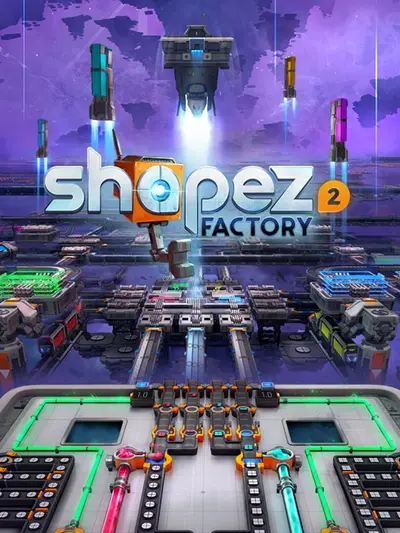
shapez 2 - Factory
76Quick answer
Quick answer
Shapez 2 is een kalme, slimme factory-builder die vooral schittert wanneer je je productie steeds verder verfijnt. De game maakt complexe automatisering verrassend toegankelijk, maar vraagt wel dat je houdt van herhalen, optimaliseren en zelf doelen stellen. Voor liefhebbers van het genre is dit een zeer bevredigende sandbox; wie meer variatie of spanning zoekt, haakt sneller af.
Ik geef Shapez 2 een 76 omdat het een uitstekend uitgevoerde niche-ervaring is, maar bewust smal blijft in variatie en emotionele prikkels.
A game that knows exactly what it wants to be
Shapez 2 is not trying to impress you with spectacle, drama, or constant surprises. It is much more focused than that: this is a construction kit for players who enjoy designing systems, smoothing out logistics, and turning a messy first draft into something elegant and efficient. That focus is the game’s biggest strength. Everything serves the act of building, refining, and optimizing, and because of that, even small improvements feel meaningful.
What stands out immediately is how approachable the game remains while its complexity steadily grows. New mechanics are usually introduced in a calm, readable way, so the game rarely overwhelms you. Instead, it invites experimentation. Mistakes are not catastrophic; they are often just a step on the way to a better layout. That makes Shapez 2 especially appealing for players who like puzzle-solving without constant pressure.
There is also a pleasing confidence to the way it presents itself. Shapez 2 does not waste time pretending to be something else. It understands that the joy of this genre comes from watching a system evolve from improvised beginnings into a machine that feels almost self-sustaining. The game’s restraint is part of its charm: it gives you room to think, room to tinker, and room to take pride in the results.
Building, planning, rebuilding
The heart of the experience is designing production lines that become larger, smarter, and more layered over time. You start with simple shapes and end up managing factories that use multiple floors, separated flows, and carefully tuned distribution. The satisfaction does not come only from reaching a goal, but from watching a system click into place. A clean, efficient line feels almost like a piece of art, especially when a small adjustment suddenly makes an entire chain run more smoothly.
That feeling is helped by how much friction the game removes. Tools for copying, reusing, and refining your setups mean you are not constantly reinventing the wheel. That matters, because the real fun is not in placing every individual belt with painful precision, but in solving bigger design problems. Shapez 2 understands this and gives you enough tools to stay creative without the interface getting in your way.
The game also encourages an architectural mindset. You are not merely laying down conveyors; you are designing a living production space with layers, routes, and room for expansion. That makes each factory feel personal. One player may favor compact, tightly organized modules, while another builds wide, sprawling industrial networks. Because the rules are so clear, your own preferences can really shine through.
The downside of that smoothness is that the game can feel almost too tidy at times. The challenge mostly comes from your own ambitions: how compact do you want to build, how far do you want to optimize, how elegant do you want your factory to become? For players who want sharper escalation or a stronger sense of urgency, that can feel a little flat. But if you enjoy the quiet satisfaction of perfecting a system, the pace works beautifully.
Progression and pacing
Progression is closely tied to your own curiosity. The game steadily unlocks more possibilities for scaling production, but it does not force you into a rigid rhythm. As a result, Shapez 2 feels more like a sandbox with direction than a linear campaign. That suits the genre well, though it also means your motivation has to come from within. There is no grand story pushing you forward; the reward is the process itself.
That process can be highly addictive for hours at a time, especially once you settle into the flow of measuring, rearranging, and improving. A factory that once jammed on a tiny bottleneck can suddenly open up after a few smart changes, and those moments are what make the game so compelling. You are constantly rewarded for paying attention, because even a modest improvement can ripple through the whole system.
Still, this is a game that asks for a specific mood. If you want a zen-like puzzle experience, there is a lot to love here. If you need variety, tension, or a strong narrative hook, you may find that the game is intentionally narrow in scope. That is not necessarily a flaw, but it is worth keeping in mind. Shapez 2 is not interested in being a little bit of everything; it wants to be excellent at one thing.
Tools that make optimization feel natural
One of Shapez 2’s biggest strengths is how well its building tools support iteration. Copying, reusing, and fine-tuning are not side features here; they are central to the experience. Once you have a working setup, you can develop it further without having to start from scratch every time. That keeps experimentation approachable and prevents complexity from turning into exhaustion.
This becomes especially important later on, when the challenge shifts from making something work to making it scale. A solution that is good enough today may need to be split, duplicated, or rerouted tomorrow. Because the tools are so smooth, that process feels less like busywork and more like a natural part of the design cycle. You are not rewriting your factory because you failed; you are improving it because you can.
That also makes Shapez 2 a strong fit for players who like to learn by doing. The game does not demand that you understand everything immediately. Instead, it lets you discover how parts interact and how a simple chain can grow into a sophisticated network. The learning curve is friendly without becoming shallow, which is a difficult balance to strike in a genre that can easily become intimidating.
Presentation and atmosphere
Visually, Shapez 2 is clear and functional, with a presentation built to preserve readability. That works very well: you can quickly spot bottlenecks and understand how your factory is evolving. The style is not flashy, but it is calm and easy to parse. Performance and responsiveness also support the experience, which matters a lot in a game where precision and iteration are central.
The soundtrack and overall audio presence are a bit more understated. That is not a problem, but it does mean the game has less personality than the very best entries in this subgenre. Everything is competent and pleasant, but rarely memorable. The atmosphere serves concentration more than it creates a strong identity of its own. That fits the game’s functional approach, though a slightly more distinctive soundscape could have added extra flavor.
Even so, it is hard to hold that against Shapez 2 too much, because the game is so clearly built around clarity and calm. It wants you to see patterns, understand relationships, and work without visual noise. In that sense, the restrained presentation is more of a strength than a limitation. Everything unnecessary has been stripped away, leaving the focus exactly where it belongs: on the act of building.
Who is Shapez 2 for?
Shapez 2 is primarily for players who already know they enjoy automation, optimization, and the slow refinement of a system. If you like games where you build production chains, solve bottlenecks, and push efficiency a little further each time, this is an excellent choice. It is approachable enough for newcomers, but deep enough to keep genre veterans busy for a long time.
Players looking for variety outside the building loop will notice the game’s deliberate narrowness more quickly. There is very little distraction from the core experience. No big story arcs, no dramatic twists, no constant shifts between wildly different play styles. That is a choice, and a very intentional one. Shapez 2 believes the satisfaction of a well-designed factory is enough on its own.
Verdict
Shapez 2 is a very strong factory-builder for players who know exactly what they want. It makes complex automation approachable, gives you plenty of freedom to experiment, and delivers a steady stream of satisfying micro-improvements. At the same time, it is a deliberately focused experience: if you are looking for more variety, story, or tension, you will notice that optimization is the main attraction.
For genre fans, that is not a weakness but the point. Shapez 2 does not aim to be an all-rounder; it aims to be a smart, calm, and deeply satisfying building machine. And in that, it succeeds with confidence. It is the kind of game where an hour can disappear while you are only moving shapes, redrawing belts, and nudging a system into a cleaner, more elegant form. That quiet sense of progress is the real reward, and Shapez 2 delivers it in abundance.
Verdict
Een slimme, rustige en zeer bevredigende factory-builder voor liefhebbers van optimalisatie.
At a glance
Pros
- Zeer toegankelijke automatiseringspuzzel met een lage instapdrempel
- Sterke tools voor kopiëren, hergebruiken en optimaliseren
- Rustige, bevredigende flow waarin elke verbetering telt
Cons
- Beperkte variatie buiten het bouwen en finetunen van systemen
- De soundtrack en sfeer blijven wat functioneel en weinig memorabel
Screenshots
More reviews
Other recent game reviews on GAME-scanner.
There are no other reviews to show yet.