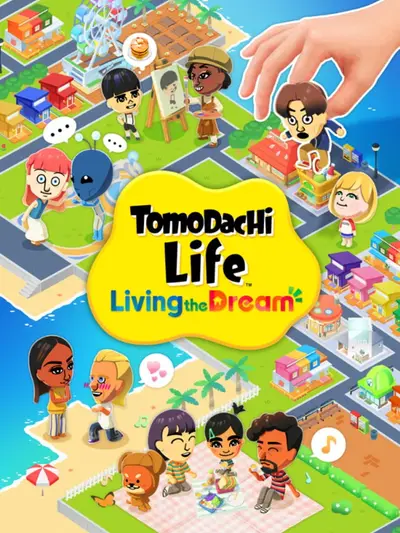
Tomodachi Life: Living the Dream
79Quick answer
Quick answer
Tomodachi Life: Living the Dream is een heerlijk vreemde levenssim die draait om creativiteit, kleine verrassingen en het plezier van kijken wat je Miis nu weer gaan uitspoken. De game is op zijn best wanneer je zelf de poppenkast aanstuurt en de absurde situaties gewoon laat gebeuren. Wie houdt van luchtige simulaties en eigenzinnige humor, kan hier makkelijk uren in verdwijnen.
De score weerspiegelt een game met veel karakter en plezier, maar ook genoeg herhaling om net onder de top te blijven.
Tomodachi Life: Living the Dream is the kind of game that knows exactly what it wants to be and never apologizes for it. It is not chasing complexity for its own sake, nor is it trying to compete with sprawling management sims that bury you in menus and optimization. Instead, it offers something much more specific: a tiny island full of oddball Miis, each with their own quirks, moods, cravings, and social impulses, all bouncing off one another in ways that are often funny, occasionally touching, and frequently absurd. The result is a life sim that feels less like a system to master and more like a toy box to poke, prod, and laugh at.
That clarity of purpose is one of the game’s biggest strengths. From the moment you start building your island, it becomes obvious that the real appeal lies in personality. You are not just creating avatars; you are setting up a cast. Whether you are recreating friends and family, inventing a bizarre lineup of original characters, or mixing the two, the game gives you enough freedom to make each Mii feel distinct without turning the process into a chore. That balance between accessibility and expression is crucial, because the entire experience depends on how much you care about the little lives you’ve set in motion.
Mii creation is the heart of the experience
The customization tools are excellent, and more importantly, they are fun to use. You can go deep into the details and fine-tune faces, features, and personality traits, or you can move quickly and create a character in a matter of minutes by answering a few simple questions. That flexibility makes the game welcoming to both meticulous players and people who just want to throw together a cast and see what happens. It also gives the island a strong sense of authorship: the more time you spend shaping your Miis, the more the simulation feels like your own strange little comedy.
What makes this especially effective is that the game never treats customization as a purely cosmetic layer. The way you build your Miis feeds directly into the humor and social dynamics that follow. A serious-looking Mii with a ridiculous personality can become a scene-stealer. A lovingly recreated friend can end up in the most embarrassing situations imaginable. The game thrives on that contrast between your intent and the simulation’s willingness to twist it into something unexpected. That tension is a huge part of the charm.
It also helps that the creation process is low-pressure. There is no need to obsess over perfection, because the game is happiest when you embrace imperfection and let the island develop its own identity. In practice, that means the best results often come from a mix of careful design and spontaneous experimentation. The more willing you are to be playful, the more the game rewards you.
Emergent comedy from tiny social disasters
Once your island is populated, the game settles into a daily rhythm of check-ins, requests, conversations, gifts, and small social developments. On paper, that sounds modest. In practice, it is where the game becomes most entertaining. The real magic of Living the Dream comes from emergent comedy: the way a simple interaction can spiral into something ridiculous because of the personalities involved and the timing of the moment. A mood swings, a relationship shifts, someone develops a crush, and suddenly a routine visit becomes the funniest thing you’ve seen all day.
This is a game that understands how much humor can come from restraint. It does not need elaborate setups or scripted punchlines every few minutes. Instead, it lets the Miis generate their own nonsense through a steady accumulation of tiny interactions. A glance, a pause, a request, a reaction, and suddenly you have a story. That makes the island feel alive in a very particular way. It is not a simulation of realism so much as a simulation of social unpredictability, and that gives it a distinct identity.
The relationships are especially enjoyable because they feel both playful and slightly chaotic. Miis can become friends, fall for one another, or get tangled up in awkward emotional moments, and the game treats all of it with a light touch. Nothing ever becomes too heavy, but the interactions still feel meaningful enough to make you care. That balance keeps the tone buoyant while still giving the island a sense of continuity. You are not just watching random events; you are watching personalities collide over time.
A relaxed structure with very little pressure
Another major strength is how easy the game is to return to. There is a real-time rhythm to some of its systems, with shops and opportunities refreshing daily, but the overall structure remains wonderfully low-pressure. You are not punished for stepping away, and you are not forced into a rigid routine. Instead, the game encourages a casual, observational style of play. You check in, see what your Miis want, hand out food or gifts, maybe play a minigame, and then leave the island to continue its strange little existence without you.
That makes Tomodachi Life: Living the Dream especially appealing as a comfort game. It is easy to pick up for a short session and just as easy to keep playing for much longer than intended. There is a soothing quality to its structure, even when the events on screen are completely ridiculous. The game never asks you to be efficient, and that absence of pressure is refreshing. It creates space for curiosity, which is exactly what this kind of simulation needs.
At the same time, that relaxed design will not suit everyone. Players who want strong progression systems, hard goals, or a sense that their decisions are constantly opening new layers of gameplay may find the experience too loose. The game is intentionally small-scale, and while that gives it charm, it also means there is a ceiling to how much mechanical depth it can offer. Once you understand the loop, the main pleasure comes from the personalities and the surprises they generate, not from escalating systems.
Presentation, tone, and the art of being silly
The presentation does a lot of work in selling the game’s tone. Visually, everything is bright, friendly, and just a little bit goofy in the best possible way. The animation style is simple, but it is used with real confidence. A tiny movement or exaggerated reaction can communicate more than a long dialogue exchange, and the game knows how to lean on that visual timing to make jokes land. It is a presentation style that values expression over spectacle, and that suits the material perfectly.
Just as important is the tone. The game is silly without being mean, weird without being alienating, and playful without becoming chaotic for chaos’s sake. That warmth matters, because it keeps the absurdity inviting. You are meant to laugh with the Miis, not at them, and that subtle difference gives the whole experience a surprising amount of heart. Even when the island descends into nonsense, it still feels like a place you want to spend time in.
There is also a pleasing sense of restraint in how the game handles its comedy. It does not overexplain the joke or force the punchline. It trusts the situation, the characters, and the player’s own imagination. That confidence is part of why the humor works so well. The game knows that the funniest thing in the room is often the thing you did not plan.
Where repetition starts to creep in
For all its charm, Tomodachi Life: Living the Dream does have a clear limitation: repetition. Many requests, activities, and cutscenes begin to recur in ways that can make the experience feel familiar sooner than you might hope. The game is built around a loop, and while that loop is often entertaining, it does not always evolve enough to keep every player engaged for the long haul. Some of the novelty comes from the personalities you create, but the underlying structure remains fairly steady.
The minigames and side diversions are also uneven. A few are enjoyable enough to break up the routine, but others feel like minor distractions rather than essential parts of the experience. When the game is focused on social interaction and emergent comedy, it is at its best. When it leans too hard on smaller mechanical diversions, the momentum can dip. That inconsistency keeps it from reaching the level of a truly great all-rounder, even if the core concept remains strong.
That said, the repetition is not necessarily a deal-breaker. For players who enjoy the vibe, the routine itself becomes part of the appeal. Checking in on familiar Miis, watching their habits, and waiting for the next ridiculous interaction can be satisfying in the same way a favorite sitcom is satisfying: you know the shape of it, but the details keep you coming back. The question is whether that style of comfort is enough for you.
Verdict
Tomodachi Life: Living the Dream is a charming, funny, and deeply specific life sim that thrives on creativity, personality, and small-scale chaos. Its excellent Mii creation tools, relaxed structure, and knack for emergent comedy make it easy to recommend to anyone who enjoys playful simulation and character-driven humor.
Its weaknesses are just as clear: repetition sets in, some minigames are uneven, and the game’s low-pressure design will not satisfy players looking for deeper systems or constant novelty. But for the audience it is aiming at, this is a wonderfully odd little island worth visiting. It is the kind of game that can make a simple daily check-in feel like an event, and that is a rare and valuable trick.
Verdict
Een warme, bizarre en vaak erg grappige sim die zijn charme grotendeels waarmaakt.
At a glance
Pros
- Heerlijke creativiteit bij het maken en aanpassen van Miis
- Sterke emergente humor uit kleine sociale interacties
- Ontspannen, laagdrempelige opzet zonder managementstress
Cons
- Veel activiteiten en verzoeken beginnen na verloop van tijd te herhalen
- Minigames en tussendoortjes zijn niet altijd even sterk
Screenshots
More reviews
Other recent game reviews on GAME-scanner.
There are no other reviews to show yet.