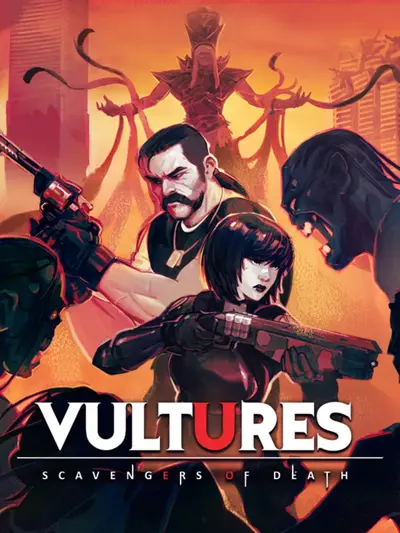
Vultures - Scavengers of Death
68Quick answer
Quick answer
Vultures - Scavengers of Death is een slimme mix van turn-based strategie en survival-horror, met een gespannen sfeer en een sterk gevoel van dreiging. De basis is overtuigend, maar technische haperingen en een paar ruwe randen houden het spel net onder de echte aanrader-status. Vooral liefhebbers van tactische horror zullen hier veel in herkennen en waarderen.
68/100 — sterk concept, sterke sfeer en slimme spanning, maar de technische en structurele haperingen drukken het eindresultaat.
A genre blend that actually earns its existence
Vultures - Scavengers of Death is the kind of indie game that does not just have a pitch; it has a point of view. Its mix of turn-based tactics, roguelike structure, and survival horror feels less like a stack of features and more like a single design idea pushed in a distinctive direction. Rather than using strategy to interrupt horror, the game makes strategy part of the horror itself. Every move forward becomes a calculation of risk, resources, and how much punishment you can afford before the run starts to collapse.
That is the game’s greatest achievement. It does not depend only on monster design or sudden shocks to create dread. Instead, it builds tension through uncertainty: limited information, fog of war, imperfect odds, and the constant possibility that one bad decision will snowball into disaster. Even after you have learned the rules, the game keeps you uneasy. That lingering discomfort is exactly what a survival-horror hybrid should aim for.
What makes the concept work so well is that it never feels like a gimmick. The mechanics, the setting, and the tone all reinforce one another. Vultures understands that horror becomes stronger when the player is asked to think carefully under pressure, not just react quickly.
Combat that turns hesitation into tension
The turn-based battles are where the game’s identity becomes clearest. You are given time to consider your options, but never enough time to feel safe. Hit percentages matter. Positioning matters. Line of sight matters. And because the game is always willing to withhold certainty, every turn carries a small but meaningful risk of going wrong. That uncertainty is not a flaw in the system; it is the system.
This is what separates Vultures from more straightforward tactical games. You are not building an unstoppable squad and methodically clearing the map. You are trying to survive with incomplete information in a hostile place that does not care whether your plan was elegant. The result is combat that feels tense even when you understand the mechanics well. A good turn can still go bad. A bad turn can become a crisis. That volatility keeps the pressure high.
The battles also benefit from how they fit the horror tone. Every encounter feels like a confrontation with the environment as much as with the enemy. The game is constantly reminding you that you are vulnerable, and that vulnerability gives the combat its bite. Winning feels earned because the game never lets you forget how easily things could have gone the other way.
Salento Valley feels ruined for a reason
Exploration is just as important as combat, and Salento Valley gives the game a strong sense of place. This is a world shaped by bioterror, cult activity, and corporate rot, and the setting has enough coherence to make the whole experience feel grounded in its own grim logic. The valley does not merely look damaged; it feels contaminated by history. Every area suggests that something went terribly wrong long before the player arrived.
The story premise supports that atmosphere well. The search for a valuable artifact gives the game a clear forward motion, but the real hook is the history of the valley itself and the forces that helped destroy it. The secret cult and Eugenesys Tech are not just background names; they help frame the world as one where power, fanaticism, and experimentation have left deep scars. That gives the game more personality than a simple monster-filled ruin would have on its own.
Visually, the game leans into a rough-edged retro survival-horror style, but it does so with purpose. The presentation is grim, textured, and recognizably its own. It does not chase polish for polish’s sake. Instead, it uses its visual identity to make the world feel hostile, decayed, and memorable.
Roguelike structure that rewards adaptation
The roguelike framework fits the game’s mood and pacing extremely well. Runs are short enough to preserve tension, yet substantial enough that each attempt feels like progress rather than repetition. Failure is part of the learning process, and the game encourages you to treat every run as an opportunity to understand routes, enemy behavior, and resource management a little better.
That loop is especially satisfying for players who enjoy systems-driven games. You are constantly making small strategic judgments: when to spend, when to save, when to risk a detour, when to cut your losses. Those decisions matter because the game is built around scarcity and pressure. It is not interested in giving you a comfortable power curve. It wants you to adapt.
The progression is not perfectly tuned, and some systems feel rougher than they should. Still, the core loop is strong enough to carry the experience. There is a real sense that the game rewards patience and careful observation, which is exactly the right philosophy for a survival-horror roguelike.
Presentation with a strong sense of grime
One of the most memorable aspects of Vultures is its art direction. The game has a wonderfully battered look that feels intentional rather than cheap. The environments, enemies, and overall visual tone all support the same mood: decayed, hostile, and faintly diseased. It is the kind of presentation that makes you feel the setting before you fully understand it.
That visual identity matters because it keeps the game from feeling generic. There are plenty of horror games that borrow retro aesthetics, but Vultures uses its style to reinforce a specific mood and a specific kind of dread. The result is a game that looks like it belongs to its own corner of the genre. Even when the mechanics are doing the heavy lifting, the presentation keeps the atmosphere intact.
The worldbuilding also benefits from this approach. The devastated valley, the cult, the corporation, and the aftermath of the attack all come together into a setting that feels like more than a backdrop. It is a place with scars, and the game is smart enough to let those scars speak for themselves.
The rough edges are hard to ignore
For all of its strengths, Vultures is held back by execution issues that are difficult to overlook. Technical problems and bugs occasionally interrupt the flow, and that is especially damaging in a game that depends so heavily on concentration and tension. When the design is asking you to make careful decisions under pressure, any accidental friction stands out immediately.
There are also moments where the game feels less polished than its best ideas deserve. Some systems could use tighter tuning, and the experience would benefit from a more thorough refinement pass. None of this destroys the game, but it does keep it from fully rising to the level of its concept. You can see the ambition clearly; you can also see where the roughness gets in the way.
That leaves Vultures in an interesting position. It is easy to admire, often genuinely tense, and full of strong ideas, but it is not yet as seamless as it wants to be. For some players, that will be enough to make the game a tough recommendation. For others, the atmosphere and tactical tension will outweigh the flaws.
Verdict
Vultures - Scavengers of Death is a smart, atmospheric, and often very tense genre experiment with a strong tactical core. When its systems click, it does an excellent job of making every encounter feel dangerous and every decision feel loaded. The combination of survival horror and turn-based strategy is not just clever on paper; it genuinely works in play.
The problem is that technical issues and uneven polish keep the game from becoming an outright essential recommendation. If you are drawn to grim tactical horror and can tolerate some rough edges, there is a lot to appreciate here. Vultures is not flawless, but it is distinctive, committed, and frequently impressive in the ways that matter most.
Verdict
Een fascinerende tactische horrorgame die vaak indruk maakt, maar net te ruw is om volledig te schitteren.
At a glance
Pros
- Sterke mix van turn-based tactiek en survival-horror
- Spannende gevechten met constante onzekerheid
- Ruwe, sfeervolle art direction met duidelijke identiteit
Cons
- Technische issues en bugs verstoren de flow
- Niet alle systemen voelen even strak of gepolijst aan
Screenshots
More reviews
Other recent game reviews on GAME-scanner.
There are no other reviews to show yet.