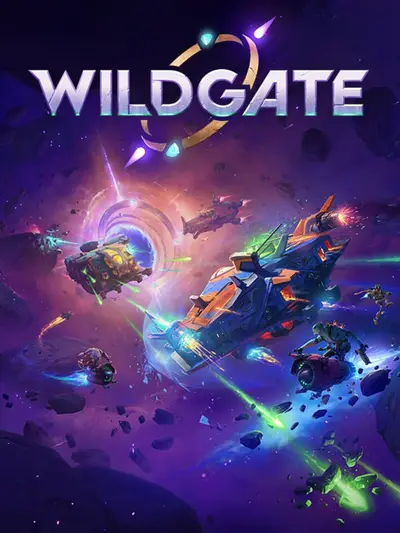
Wildgate
74Quick answer
Quick answer
Wildgate is een chaotische multiplayercocktail die ruimtegevechten, first-person actie en teamcoördinatie verrassend soepel samenbrengt. De beste momenten ontstaan wanneer een squad goed op elkaar ingespeeld is en een match ineens omslaat van ordelijke planning naar pure paniek. Tegelijk voelt het spel nog wat smal in inhoud en variatie, waardoor de eerste indruk sterker is dan de lange adem.
Een sterke, vaak spannende basis tilt Wildgate boven gemiddeld uit, maar de beperkte variatie houdt het net onder de top.
Wildgate is exactly the kind of multiplayer game that announces its intentions immediately: not a tidy, controlled shooter, but a noisy space caper where communication, timing, and improvisation matter more than individual heroics. It blends tactical ship-to-ship combat with fast first-person action and wraps both layers in a constant pressure that makes nearly every decision feel meaningful. The result is messy in the best way possible: often chaotic, frequently tense, and at its best, genuinely memorable.
What makes Wildgate stand out is that it does not try to perfect a single genre and call it a day. Instead, it fuses several familiar ideas into something that feels like its own brand of space piracy, team-based panic, and high-risk extraction. That works because the game understands an important truth: chaos is only fun when it remains readable. You may lose control often, but you rarely lose the thread entirely. That balance is where Wildgate finds its appeal, turning every match into a story about narrow escapes, bad calls, clutch saves, and the constant possibility that one good move can flip everything.
Gameplay and match flow
Wildgate’s core loop lives in the tension between two intertwined layers. On one side is the ship itself, a larger system that demands maintenance, positioning, and coordination. On the other is the first-person action, where you are shooting, boarding, defending, and scrambling to survive in real time. The game never treats those as separate modes. They are part of the same pressure cooker, and that is what gives the experience its pulse. A mistake in one place can ripple across the entire crew, while a smart decision can rescue a run that looked doomed seconds earlier.
That structure makes every match feel active and reactive. You are not just fighting other players; you are also dealing with environmental hazards, scavenging for weapons and upgrades, and trying to secure the Artifact before another crew beats you to it. The result is a constant sense of motion. One moment you are plotting a route, the next you are repairing damage, and after that you are suddenly boarding an enemy ship because the situation has changed again. Wildgate is at its best when those transitions are smooth and the whole team is moving with a shared sense of urgency.
The controls help a lot. Movement feels responsive, the gunplay has enough snap to keep firefights lively, and the game generally stays out of its own way. That matters because Wildgate asks players to juggle a lot at once. You need to read the battlefield, react to threats, decide when to commit, and know when to pull back. When the systems click, the whole thing feels like a perfectly timed disaster: frantic, but never sloppy.
Teamwork as the engine
Wildgate is a game that comes alive when a crew is actually working together. Its best moments are not built around one person carrying the match, but around a group of players coordinating under pressure. Someone calls out damage on the ship, another jumps out to intercept an enemy, and the rest of the team tries to secure loot or keep the escape route open. That kind of shared problem-solving gives the game a kind of energy that many multiplayer shooters never quite reach. Success here feels collective, and that makes the highs hit harder.
That dependence on communication is both a strength and a limitation. With a reliable squad, a headset, and players who understand each other’s habits, Wildgate can be fantastic. Even small victories feel earned, and the big reversals can be the sort of moments you remember long after the session ends. But if the team is disorganized or the communication breaks down, the magic fades quickly. Wildgate is not especially forgiving of half-hearted coordination. It wants players who are willing to talk, adapt, and accept that the game will punish hesitation.
That makes it less of a casual drop-in experience than it may first appear. The game is still approachable, but it is most rewarding when you commit to learning its rhythm with a regular group. The more familiar your crew becomes with each other, the more the chaos turns into something you can actually steer.
Progression, loot, and tension
Wildgate’s structure is built around risk and reward. You are constantly searching for weapons, upgrades, and opportunities to improve your position while racing toward the Artifact and trying not to get wiped out along the way. That gives each match a clear arc. It is not just a matter of surviving random encounters; it is about deciding how much danger you are willing to accept in pursuit of a better outcome. The game keeps asking you to weigh greed against caution, and that tension is a big part of why it works.
When a run starts going well, the momentum feels excellent. Your crew gathers gear, secures advantages, and begins to read the flow of the round more effectively than the opposition. But the same structure also means that a single bad decision can undo a lot of progress. A mistimed push, a poor escape route, or one moment of inattention can turn a promising match into a scramble. That volatility is not just decoration; it is the point. Wildgate wants every success to feel earned because failure is always close by.
At the same time, this is where the game’s limits become visible. The foundation is strong, but the overall package is narrower than the best matches suggest. Once the novelty of the blend wears off, you start noticing how much the experience depends on player coordination and how little variety exists outside the core loop. The systems are competent and often exciting, but they do not always expand enough to keep the experience feeling fresh over a long stretch.
Presentation and atmosphere
Wildgate has a strong visual identity. It leans into colorful sci-fi spectacle rather than sterile realism, and that choice gives the game personality. The action is readable, the environments are easy to parse, and the whole presentation has a playful edge that suits the absurdity of the premise. Space here is not a quiet backdrop; it is a dangerous, unstable playground where everything seems ready to go wrong at once.
The atmosphere benefits from the game’s reliance on human interaction as much as it does from the art direction. Wildgate often feels like a shared emergency. The tension comes not only from enemy crews, but from the possibility that your own team is one mistake away from disaster. That makes the highs feel higher, but it also means the experience is closely tied to the quality of the group you bring with you. With the right people, the chaos is exhilarating. Without them, it can become exhausting.
There is also something appealing about how the game embraces its own absurdity. It does not pretend to be a grand simulation of space warfare, and that restraint helps. Instead, it focuses on delivering a readable, energetic playground where every system exists to create friction, pressure, and the occasional glorious collapse. That clarity of purpose is one of Wildgate’s biggest strengths.
Content and long-term value
The main concern with Wildgate is not that it fails to work; it is that it can feel a little lean over time. The core loop is strong enough to support many sessions, but the game does not always offer enough variety to keep surprising you once the novelty settles. The same broad rhythm repeats often enough that the experience can start to feel familiar sooner than you might hope. That does not make it bad, but it does limit how far it can stretch.
As a result, Wildgate is best understood as a focused multiplayer experience rather than a sprawling one. If you want a game that keeps throwing new modes, deep progression systems, or endless content at you, this may feel a bit narrow. If you want a high-energy team game that can generate unforgettable moments through coordination and pressure, it is much easier to recommend. The game knows what it is, and it executes that idea with confidence.
Verdict
Wildgate is a smart blend of ship combat and first-person action that delivers real tension, strong teamwork moments, and a satisfying sense of momentum. Its controls are responsive, its gunplay feels good, and its match structure creates the kind of high-stakes chaos that multiplayer games often promise but rarely deliver this cleanly. When a squad clicks, Wildgate can be excellent.
The catch is that its strengths are also where its limits show. The content is relatively limited, the repetition becomes noticeable, and the game leans heavily on having a reliable crew. That keeps it from feeling like a truly essential long-term multiplayer staple. Still, as a focused, energetic, and stylish experience, it makes a strong case for itself. If you have friends to play with and enjoy games where teamwork and disaster are separated by a very thin line, Wildgate is well worth your time.
Verdict
Wildgate is een energieke en slimme multiplayergame die vaak schittert, maar nog niet genoeg breedte heeft om echt onmisbaar te zijn.
At a glance
Pros
- Sterke mix van ship combat en first-person actie
- Responsieve besturing en prettig schietgevoel
- Spannende teammomenten waarin alles kan kantelen
Cons
- Beperkte inhoud en herhaling worden na verloop van tijd zichtbaar
- Sterk afhankelijk van goede communicatie en een vaste crew
Screenshots
More reviews
Other recent game reviews on GAME-scanner.
There are no other reviews to show yet.