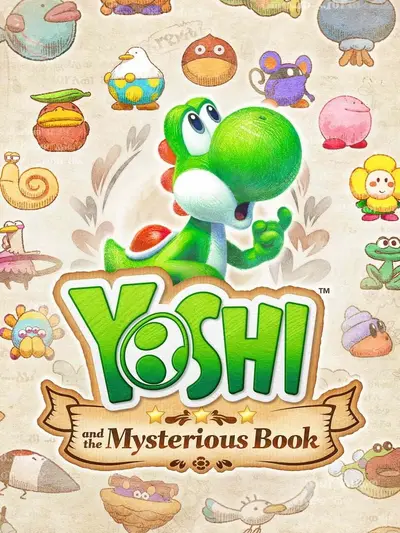
Yoshi and the Mysterious Book
78Quick answer
Quick answer
Yoshi and the Mysterious Book is een charmante, speelse platform-adventure die vooral uitblinkt door zijn nieuwsgierigheid: elke pagina introduceert nieuwe ideeën, kleine ontdekkingen en slimme puzzels. De game is zelden hard, maar wel constant inventief, waardoor hij zowel jonge spelers als volwassenen met zin voor experimenteren kan bekoren. De herhalende opbouw en bescheiden visuele impact houden hem net onder de absolute top.
78: sterk in charme, variatie en ontdekking, maar de herhaling en lage uitdaging houden het net onder de absolute uitblinkers.
A world built around curiosity
Yoshi and the Mysterious Book is the kind of game that wants to charm you before it challenges you. The setup is wonderfully odd in the best Nintendo tradition: a talking book named Mr. E falls from the sky, Yoshi gets drawn into its pages, and the whole adventure becomes an investigation into strange creatures and the secrets they hold. It is a premise that immediately gives the game a distinct identity. Rather than treating its world as a backdrop for standard platforming, it turns the world itself into the main attraction.
That is a smart fit for Yoshi. The character has always worked best in games that emphasize tactile movement, playful interactions, and a sense of childlike wonder. Here, those strengths are wrapped in a bookish structure that makes every level feel like a chapter waiting to be explored. The result is a game that feels less like a race to the finish and more like a guided tour through a living storybook. You are not just moving from left to right; you are reading the environment as you go.
From the outset, the game makes it clear that it values discovery over pressure. It is calm, inviting, and full of little surprises. That does not mean it lacks substance. On the contrary, the best moments come from how confidently it turns simple ideas into satisfying interactions. The game knows exactly what kind of mood it wants to create, and it sticks to that vision with admirable consistency.
Gameplay that rewards experimentation
The moment-to-moment gameplay is built around accessibility. Yoshi moves with the familiar ease fans will expect, and the platforming rarely asks for punishing precision or fast reactions. Instead, the game encourages you to experiment. You poke at the environment, test how creatures behave, and revisit spaces once you understand more about what they are hiding. That makes the experience feel active without becoming stressful.
What stands out most is how often the game rewards curiosity. Discoveries are not just optional extras; they are the core of the design. You are constantly being nudged to look one step beyond the obvious path, and the game is good at making those detours feel worthwhile. Hidden routes, creature interactions, and small environmental tricks all contribute to a sense that you are always learning something new. Even when the challenge is light, the act of figuring things out keeps the experience engaging.
The puzzle design deserves special mention. The game’s puzzles are clever without being intimidating, and they fit neatly into the broader exploratory structure. They rarely stop the flow for long, but they do ask you to think. That balance is important, because it keeps the game approachable while still giving your brain something to chew on. For players who enjoy cozy puzzle-platforming, this is a very appealing mix.
Pacing, structure, and progression
One of the game’s biggest strengths is how steadily it introduces new ideas. The structure unfolds in a way that keeps the adventure feeling fresh, even though the overall tone remains gentle. Each area seems to add a new wrinkle, whether that is a creature type, a small mechanical twist, or a different way of interacting with the environment. The game has a good sense of pacing, and it understands that variety matters just as much as difficulty.
Progression is tied closely to observation. As you uncover more of the book’s inhabitants, the world feels more complete. That gives the game a satisfying sense of accumulation. You are not simply collecting for the sake of collecting; you are building knowledge. That subtle shift makes the journey feel meaningful, because each discovery adds context to the world and encourages you to keep exploring.
At the same time, the game’s structure has a clear ceiling. Because it is so committed to being welcoming and low-pressure, it never really pushes into tougher territory. The challenge stays very mild, and that means tension is limited. For some players, that will be a welcome relief. For others, it may leave the adventure feeling a little too safe. The game is strongest when you embrace its gentle rhythm, not when you expect it to escalate dramatically.
Presentation and personality
Visually, the game is warm, colorful, and full of personality. The book-world concept gives the art team plenty of room to be inventive, and the result is a setting that feels playful and alive. The creatures are imaginative, the environments are packed with small details, and the whole presentation supports the idea that you are exploring a storybook with secrets tucked into every page.
That said, the visual style does not always hit with the force you might hope for from a major Yoshi release. It is charming, but sometimes a little restrained. There are moments where the game looks lovely rather than striking, and while that is not a problem in itself, it does mean the presentation can feel less memorable than the concept suggests. Even so, the atmosphere remains strong throughout, and the game’s personality comes through clearly in every area.
What helps most is the consistency of tone. The game never loses sight of what it is trying to be. It is whimsical without becoming chaotic, friendly without becoming bland, and creative without feeling forced. That coherence goes a long way toward making the adventure feel polished and inviting.
What holds it back
The main drawback is repetition. Because the game leans so heavily on a discovery-first structure, some sections can start to feel similar over time. If you are fully invested in the loop, that may not matter much. But if you are looking for a platformer that constantly escalates or reinvents itself, this one may begin to feel predictable. The game’s ideas are good, but it does not always push them as far as it could.
The other limitation is the lack of real danger. The challenge remains so mild that the game rarely creates tension, and that can reduce the sense of accomplishment for players who like to be tested. It is clearly designed to be approachable, and in that sense it succeeds. Still, the trade-off is that the experience can feel a little too gentle at times.
Even with those caveats, there is a lot to admire here. The game is focused, confident, and full of charm. It does not try to be a grand reinvention of the genre. Instead, it aims to be a thoughtful, cozy adventure built around discovery, and it largely succeeds on those terms.
Conclusion
Yoshi and the Mysterious Book is a delightful platform adventure for players who enjoy curiosity-driven design. Its strongest qualities are easy to appreciate: a strong focus on discovery, accessible platforming, clever light puzzles, and a world packed with creative creatures and surprises. It is the kind of game that makes you want to look around one more corner, just to see what the book is hiding.
Its weaknesses are equally clear. The structure can become repetitive, and the low challenge means the game rarely builds much tension. But those limitations are tied to the same design philosophy that gives the game its charm. This is a gentle, well-made, and often very lovely experience that knows its audience. If you want a straightforward platformer with high stakes, look elsewhere. If you want a cozy adventure that rewards attention and imagination, this is one of the more appealing Yoshi outings in quite some time.
Verdict
Een warme, slimme Yoshi-game die schittert in ontdekking, maar net niet genoeg ruggengraat heeft om echt topklasse te worden.
At a glance
Pros
- Sterke focus op ontdekking en nieuwsgierigheid
- Speelse, toegankelijke platforming met slimme lichte puzzels
- Charmante wereld vol creatieve creatures en verrassingen
Cons
- De opbouw kan na verloop van tijd repetitief aanvoelen
- De uitdaging blijft erg mild, waardoor spanning soms ontbreekt
Screenshots
More reviews
Other recent game reviews on GAME-scanner.
There are no other reviews to show yet.