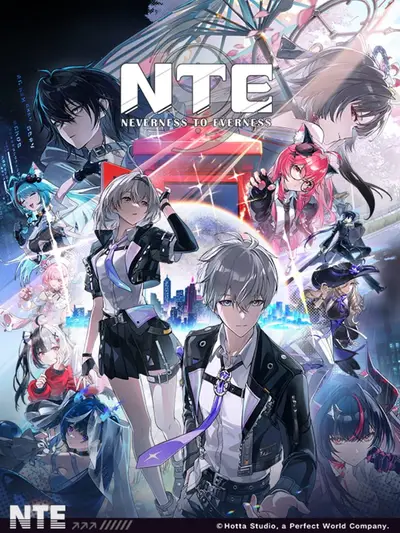
NTE: Neverness to Everness
74Quick answer
Quick answer
NTE: Neverness to Everness is een ambitieuze open-world RPG die stadssimulatie, verhaal, gevechten en gacha verrassend soepel samenbrengt. De neonstad leeft, de systemen geven je altijd iets te doen en de game heeft genoeg charme om je lang vast te houden. Tegelijk blijft niet alles even strak: combat, menu’s en sommige personages voelen nog te rommelig of te druk aan.
Ik geef NTE een 74 omdat de stad, systemen en sfeer sterk genoeg zijn om de rommelige combat en overvolle interface te dragen.
NTE: Neverness to Everness is the kind of game that looks like it should buckle under the weight of its own ambitions. It wants to be an open-world RPG, a gacha-driven progression game, a city-life sandbox, a supernatural mystery, and a constant stream of side activities all at once. That is a lot to ask from any release, especially in a genre already packed with overlapping systems and familiar formulas. Yet NTE does something surprisingly difficult: it keeps most of those ideas in the same conversation instead of letting them fight each other.
The result is a game that feels busy, but not necessarily messy. More importantly, it feels alive. From the first hours, NTE makes it clear that its real selling point is not just combat or story, but the sensation of existing in a neon-lit city where something odd is always happening just out of frame. That sense of place is what gives the whole experience its momentum.
Hethereau is the real star
Hethereau is one of the game’s biggest strengths, and it is easy to see why so much of NTE’s design revolves around it. This is not a generic fantasy hub or a sterile sci-fi backdrop. It is a dense urban playground filled with traffic, alleyways, storefronts, odd jobs, and strange incidents that make the city feel like more than a mission board with buildings attached. Walking through it or driving across it has a natural pull because the game keeps offering reasons to detour.
That matters because open-world games live or die by their ability to make movement feel worthwhile. NTE understands that. A commission might be waiting on the other side of the district, but on the way you may notice a side activity, a hidden corner, or a situation that nudges you off course. Those small interruptions are not distractions from the experience; they are the experience. The city is designed to keep you curious, and that curiosity is what makes the game easy to keep playing.
Visually, Hethereau also leaves a strong impression. The neon palette, the urban clutter, and the supernatural touches all work together to create a distinct identity. The game is not trying to be subtle, but it is trying to be memorable, and that goes a long way in a crowded genre.
A gameplay loop that feeds itself
NTE’s best quality is how its systems reinforce one another. You are not just fighting enemies or following story beats. You are exploring, driving, taking commissions, managing progression, and reacting to whatever the city throws at you. That creates a loop that feels active without becoming exhausting. There is always another task to complete, another reward to claim, or another route to take through the city.
This is where the game becomes especially effective as a long-session experience. It gives you enough structure to keep moving, but enough variety to avoid feeling like a checklist. The rhythm of taking a job, traveling to it, dealing with whatever happens, and then returning to the broader progression loop is satisfying in a way that many larger, more polished games still struggle to achieve. NTE may not be the most refined example of its type, but it often feels like one of the most naturally paced.
That said, the game’s ambition is also its main source of friction. There are a lot of systems here, and not all of them are equally elegant. Some mechanics feel like they exist because the game wanted another layer, not because that layer adds much depth. The result is a structure that can occasionally feel overbuilt. It is rarely broken, but it is often busier than it needs to be.
Combat gets the job done
Combat in NTE is competent, functional, and occasionally flashy, but it is not the feature that will define the game for most players. It fits the supernatural premise well enough, and the presentation helps sell the action, but the actual mechanics rarely rise above solid. Encounters are enjoyable in the moment, yet they do not often leave a lasting impression once the fight is over.
That is not a fatal flaw, because NTE is clearly not relying on combat alone. The broader experience is built around movement, atmosphere, and routine. Still, if you are hoping for a deeply refined action system with a lot of tactical nuance, this may not be the game that scratches that itch. The battles are there to support the loop, not to dominate it.
In practice, that means combat is best understood as one part of a larger urban fantasy package. It contributes to the flow, but it does not steal the show. For some players that will be enough; for others it will be the area where the game feels most like a compromise.
Progression and the pull of “just one more”
If there is one area where NTE becomes genuinely sticky, it is progression. The game is built to keep you in a constant state of forward motion. New goals appear frequently, rewards arrive at a steady pace, and there is always some small improvement to chase. That makes the game dangerously easy to sink time into, because it is very good at turning short play sessions into longer ones.
The structure also suits the fantasy of being an unlicensed Anomaly Hunter working out of Eibon, a rundown antique shop that keeps the lights on by taking commissions. That setup gives the progression a sense of place. You are not just leveling up for the sake of it; you are building a life, a crew, and a reputation in a city that is constantly throwing strange problems at you. The game does a nice job of making that routine feel like a story in itself.
The gacha framework will always be a point of friction for some players, of course. Even when a game is relatively generous, the model itself is not for everyone. NTE is easier to enjoy than many of its peers in that regard, but it is still a game that asks you to accept a live-service structure as part of the package.
Characters, humor, and tone
NTE’s cast is colorful, but not always evenly effective. The game leans hard into eccentric personalities, quick banter, and a tone that shifts between slice-of-life comedy, sci-fi weirdness, and supernatural drama. When it works, it gives the game a lot of charm. The city feels populated by people with actual presence, and the group dynamic helps the world feel less like a stage and more like a place where relationships are constantly evolving.
When it does not work, the issue is usually tone. Some jokes land cleanly, while others feel like they are trying a little too hard to be memorable. A few characters can be irritating rather than endearing, and the game’s more exaggerated moments may test your patience if you prefer a more restrained approach. NTE is not shy about being playful, and that confidence is admirable, but it also means the experience will not be equally appealing to everyone.
Still, there is enough personality here to keep the world from feeling generic. Even when a scene misses, it usually misses with intent. That is preferable to a game that plays it safe and leaves no impression at all.
Presentation and interface issues
On a visual level, NTE does a lot right. The lighting is striking, the city has texture, and the overall presentation gives the game a polished, high-energy feel. It is the kind of game that benefits from being seen in motion, because the combination of color, speed, and urban density helps sell the fantasy of living inside a supernatural metropolis.
The interface, however, is a different story. With so many systems competing for attention, the menus can become cluttered and awkward. Information is not always presented in the cleanest way, and there are moments where the game’s ambition outpaces its usability. That does not ruin the experience, but it does make the game feel less elegant than it could be. When a title asks you to juggle this many layers, clarity matters a lot.
Verdict
NTE: Neverness to Everness is a strong foundation for a very specific kind of long-term play. It is stylish, ambitious, and more cohesive than its crowded feature list might suggest. The city is compelling, the systems support each other well, and the progression loop is satisfying enough to keep pulling you back in. At the same time, the combat is merely decent, the menus can be clumsy, and not every character or joke lands as intended.
Even so, the overall experience is easy to recommend to players who enjoy open-world RPGs that are more about inhabiting a place than simply clearing content. NTE is messy in spots, but it has enough atmosphere, rhythm, and personality to make that mess worth navigating. It may not be the most refined game in its space, but it is one of the more distinctive ones.
Verdict
Ambitieus, stijlvol en vaak erg leuk, zolang je de rommelige randjes accepteert.
At a glance
Pros
- Levendige neonstad met veel sfeer en sterke art direction
- Slimme mix van verkennen, rijden, opdrachten en progressie
- Veel systemen ondersteunen elkaar en geven de game een fijn ritme
Cons
- Combat blijft functioneel maar zelden echt spannend
- Menu’s en systeemlagen voelen soms te druk en onhandig
- Niet elke personagegrap of toonkeuze landt even goed
Screenshots
More reviews
Other recent game reviews on GAME-scanner.
There are no other reviews to show yet.