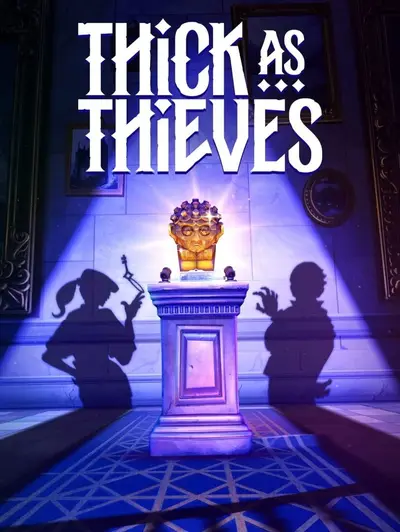
Thick as Thieves
58Quick answer
Quick answer
Thick as Thieves heeft een sterke kern: sluipen, plannen en ontsnappen voelen vaak precies goed. De setting en de heist-opzet geven het spel karakter, maar de beperkte campagne en half uitgewerkte systemen remmen het geheel duidelijk af. Daardoor blijft het een interessante, maar ook frustrerende stealthtitel die meer belooft dan hij nu waarmaakt.
Ik waardeer de sterke stealthkern en sfeer, maar de beperkte campagne en half uitgewerkte systemen drukken het totaal naar een nette, gemengde voldoende.
A heist fantasy with a strong core
Thick as Thieves understands the basics of a good thief fantasy immediately: tension, observation, and the feeling that you are slowly mapping out every corner of a location before making your move. At its best, it is a stealth game that asks you to listen, wait, and read routes as if you were preparing a real break-in. That makes the foundation appealing right away, especially because the game does not hide its stealth behind unnecessary excess or constant spectacle. Everything here is built around sneaking, planning, and escaping, and that focus gives the game a clear identity.
The setting helps a great deal. Its alternate-history early-1900s Scotland gives the world a distinct personality, with a mix of magic and emerging technology adding just enough strangeness to make the heists memorable. Kilcairn feels like a place where old wealth, social tension, and mysterious forces all overlap. It is not a huge open world, but it is a convincing backdrop that strengthens the mission structure more than you might expect on paper. Each job feels like a small story, as if you are not just entering a level but slipping into a carefully guarded corner of a larger, darker city.
Stealth that often lands just right
The best thing about Thick as Thieves is how the gameplay rewards patience. Enemies and patrols are usually placed well enough to make you think about routes, and the levels often offer multiple approaches. You can scout a room, discover an alternate path, and come back with a plan that feels genuinely yours. That is exactly the kind of design stealth fans want: not the illusion of choice, but real room to play smart. The game rarely insists on one perfect solution; instead, it invites you to build a safe and efficient route on your own terms.
The escape moments work surprisingly well too. When a plan goes wrong and you still have to get out, the game creates the right kind of chaos. Not everything is equally polished, but the tension of a heist that can still be salvaged gives the game personality. These are the moments when your pulse rises, when you need just one more door, one more shadow, or one more distraction, and the whole mission shifts from controlled precision into improvisation. That makes the best heists genuinely memorable.
The game is also approachable without losing its identity. Newcomers to the genre should find the entry point friendly enough, while experienced players still get enough room to optimize routes and weigh risks. That balance matters, because many stealth games lose their edge when they become too automated or over-explained. Thick as Thieves mostly avoids that trap by setting up a clear play space and letting you wrestle with it yourself.
A world that chooses atmosphere over scale
The presentation may not be flashy, but it is thoughtful. The dark streets, the heist locations, and the blend of old-world architecture with arcane details give the game a recognizable identity. This is a world that does not scream for attention; it works through suggestion. You feel that there is more happening behind closed doors than you can see directly, and that is exactly the right mood for a game about stealing, eavesdropping, and staying unseen. In a stealth game, atmosphere is not decoration. It is part of the tension. Here, that is understood well.
What makes the setting especially effective is that it is not just cosmetic. The combination of magic and early technology gives the heists a subtle twist, so you never feel like you are simply moving through a generic historical city. There is a slight sense of unease in the world that makes every building, street, and target more interesting. Even the quieter moments linger because the game understands how important context is for suspense. A silent corridor or a guarded courtyard carries more weight when you feel that it belongs to a larger, stranger society.
Progression and content: visibly limited
The biggest weakness is the size and completeness of the campaign. Thick as Thieves often feels more like a promising slice of a bigger idea than a fully expanded game. There is clearly a strong foundation to build on, but the amount of available scenarios and the overall variety remain modest. As a result, it is easy to feel like you have already seen the best side of the game before long. That is a shame, because the core mechanics are exactly the kind that benefit from more situations in which they can really shine.
Progression does not always compensate for that. Some systems are explained too vaguely or too sparingly, so instead of feeling like you are mastering the game, you may feel like you are simply testing what it wants from you. That is less of a problem for newcomers, because the entry point is friendly and the basics become clear quickly. For genre veterans, though, it can feel like a simplified version of a style that thrives on precision and nuance. You can tell the game wants you to experiment, but it does not always communicate clearly why one approach works or what you should have done differently.
That also limits replay value. Heist games often live and die by the appeal of trying a mission again with a different route, different timing, or a different risk profile. That loop is present here, but the limited content means you move through the available variety faster than you would like. The result is a game that works well in short bursts, but is less convincing as a long-term obsession. Players looking for a compact stealth experience may be satisfied; those hoping for a richer campaign will likely be left wanting more.
Technical polish, ambition, and the limits of the concept
The technical and structural finish makes it clear that Thick as Thieves did not quite get the time it needed to fully realize its ambitions. You can feel that not only in the limited amount of content, but also in the way some ideas remain half-developed. The game has a clear sense of how a smart heist should feel, but not every system receives the same level of clarity or care. That creates a gap between what you think the game wants to be and what it actually delivers on screen.
That becomes especially visible in how the world reacts to your actions. When everything comes together, it works very well: you sneak, observe, seize your chance, and vanish back into the shadows. But once the structure starts to crack, the limitations become harder to ignore. The game leans heavily on its core idea rather than on a broadly developed whole. It is not broken, but it is clearly unfinished. And because the foundation is so good, that incompleteness feels even more disappointing.
Solo or co-op: a game that benefits from company
Although Thick as Thieves is fully playable solo, the game seems to breathe more easily in co-op. That makes sense: a heist fantasy often becomes stronger when you can divide tasks, coordinate distractions, and improvise together when a plan falls apart. Playing alone still works, and at times works very well, but the limitations of the content and the explanation become more noticeable. With a partner, the focus shifts more naturally toward timing and teamwork, which softens some of the rougher edges in the design.
Still, co-op does not solve the underlying issues. It mainly makes the experience smoother and more social, not necessarily deeper. The core remains the same: a strong stealth foundation, an atmospheric world, and a series of heists that are often tense enough to keep you engaged, but not expansive enough to keep surprising you for long. That makes the game most appealing to players who know exactly what they want: a compact, affordable stealth experience with a clear identity.
Verdict
Thick as Thieves is not a failure, but it is a game that clearly needed more time, more content, and more polish for its best ideas to fully land. The stealth foundation is strong, the atmosphere is convincing, and the heist fantasy works more often than not. But the limited campaign, unclear systems, and persistent sense of incompleteness keep the final result firmly in the territory of a good but flawed recommendation for players who specifically want this kind of compact stealth experience. For everyone else, it is an interesting find with too many rough edges, a game that keeps showing you what it could have become instead of fully standing on what it is now.
Verdict
Aanrader voor stealthfans die met beperkte content kunnen leven, maar duidelijk geen volwaardige klassieker.
At a glance
Pros
- Sterke stealthbasis met echte routeplanning
- Sfeervolle alternatieve Schotse setting
- Heists en ontsnappingen leveren vaak spannende momenten op
Cons
- Campagne en contentaanbod voelen beperkt
- Sommige systemen en doelen zijn te vaag uitgelegd
Screenshots
More reviews
Other recent game reviews on GAME-scanner.
There are no other reviews to show yet.